You step on the scale every morning, but are you really getting accurate, meaningful data? With so many bathroom scales on the market ranging from basic analog dials to high-tech smart devices that track 28 body metrics, it is easy to feel overwhelmed. The truth is, choosing the right bathroom scale starts with knowing what you actually need. Whether you are tracking weight loss, monitoring body composition, or sharing with family, the best scale is not always the most advanced. It is the one that delivers consistent, reliable results and fits seamlessly into your routine.
This guide cuts through the noise using real testing data, expert insights, and user needs to help you make an informed decision. We will break down the three main types of scales, reveal which features actually matter, and show how to avoid common mistakes that skew your readings. You will learn why digital beats analog for accuracy, how smart scales estimate body fat, and what to look for in app integration, design, and safety.
Choose the Right Scale Type

Your first decision shapes everything. Mechanical, digital, or smart? Each serves different needs, and choosing wisely means matching the scale type to your goals.
Pick Mechanical for Simplicity
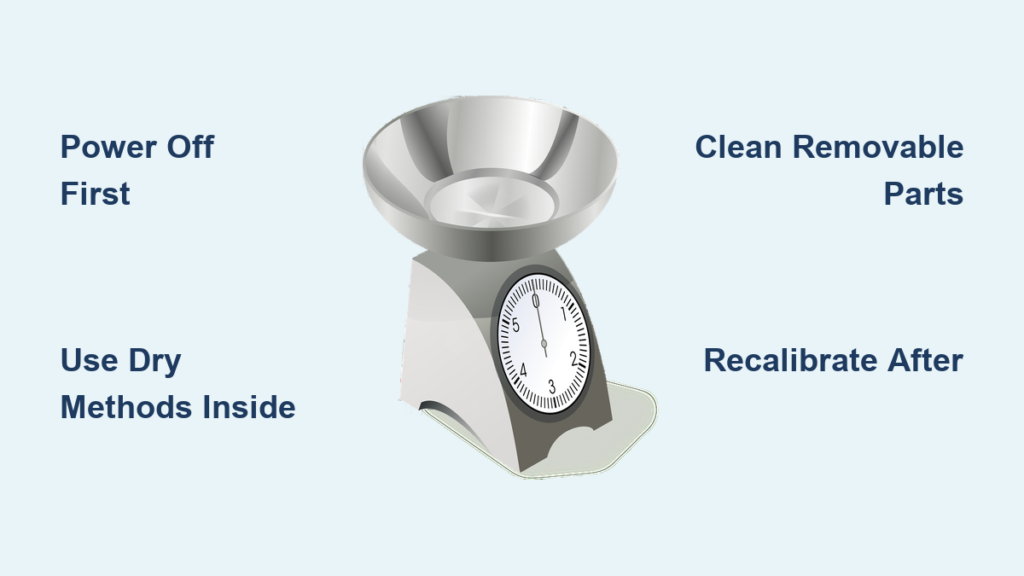
If you want no batteries, no apps, and no fuss, a mechanical scale might seem appealing. These analog models use springs and levers to display weight via a needle dial. They are durable, instantly ready, and often have large, easy-to-read faces ideal for users with vision challenges.
But there is a catch. They are less accurate. A 2013 BMC Public Health study found mechanical scales often start at approximately 2.09 pounds before you even step on, skewing all readings. They typically measure only to the nearest 1 pound or 0.5 kg, missing small changes. Over time, the needle can drift, and there is no way to track trends unless you write them down.
Mechanical scales work best for users who value battery-free, low-tech simplicity. Avoid if you need precise tracking or want to monitor progress over time.
The Adamson A27 illustrates this category. It has an accuracy score of 4.8 out of 10 and a consistency of plus or minus 1.14 pounds. It offers no digital readout, no data logging, a large platform, and an anti-slip surface. You must manually calibrate it. While durable, mechanical scales are outperformed by digital models in every accuracy test.
Choose Digital for Accurate Weight
For precise, consistent weight measurement, digital scales are the clear winner. They use load cell sensors to deliver readings down to 0.1 pound or 0.05 kg, making them ideal for tracking small changes over time.
These sleek, low-profile models usually feature tempered glass platforms, backlit LCD or LED displays, and auto-on functionality. Most run on AAA batteries and include a tare function, letting you zero out shoes or clothes. Some come with carpet feet for stable readings on soft flooring.
Digital scales are tested and proven accurate. The Etekcity EB9380H, for example, scored 9.1 out of 10 for accuracy and has a consistency of just 0.23 pounds across repeated measurements.
Digital scales work best for anyone who wants reliable daily weight tracking. Avoid if you need body composition data or automatic syncing.
Top digital models include the Etekcity EB9380H for most precise and compact design, the Greater Goods Digital Scale for budget-friendly use with a large backlit display, and the RunStar D550 for 550 pound capacity ideal for heavier users. Digital scales strike the perfect balance between accuracy, simplicity, and affordability, making them the go-to choice for most households.
Upgrade to Smart for Body Composition
If you are serious about fitness or health tracking, a smart scale goes beyond weight to estimate body fat, muscle mass, water weight, BMR, and more using bioelectrical impedance analysis.
Here is how it works. When you step on barefoot, a safe, low-level electrical current passes through your feet. Since fat and muscle conduct electricity differently, the scale calculates resistance and estimates composition using proprietary algorithms.
These scales sync via Bluetooth or Wi-Fi to apps like Apple Health, Google Fit, or Fitbit, automatically logging data and showing trends over time. Many support multi-user recognition, ideal for families.
Smart scales work best for fitness enthusiasts, goal trackers, and families. Avoid if you have a pacemaker because BIA current is unsafe, or if you want medical-grade accuracy.
A key limitation exists. Body fat percentage is an estimate. A 2016 Consumer Reports test found smart scale body fat readings off by 21 to 34 percent versus DEXA scans, the gold standard. A 2021 French study confirmed that weight is accurate but body fat is not. Use trends, not absolute numbers, for insights. Smart scales do not measure better than digital models for weight. They just track more. Their real value is in long-term trend analysis, not precision.
Prioritize Accuracy and Consistency
No matter the type, accuracy is non-negotiable. But what does accurate really mean?
Understand Accuracy vs. Consistency
Accuracy refers to how close the reading is to your true weight, measured against a calibrated lab scale. Consistency refers to how reliably it gives the same result under the same conditions.
A scale can be consistent but inaccurate, always off by 2 pounds. It can also be accurate but inconsistent, jumping up and down. You want both.
Experts test accuracy using a calibrated lab scale accurate to 0.01 pound. They test with 7 loads from 25 to 200 pounds and take multiple readings at different positions to test stability. Standard deviation measures consistency, with lower values indicating more consistent results.
The Wyze X has a consistency of 0.11 pounds, among the best. The Adamson A27 mechanical scale varies by 1.14 pounds, over 10 times less consistent. Look for tested consistency scores when comparing models.
Avoid Common Accuracy Killers
Even the best scale gives bad data if used wrong. Common mistakes include weighing at different times of day, since morning versus night can vary by 5 or more pounds. Standing off-center, especially on small platforms, causes problems. Using on carpet without feet causes instability. Not zeroing the scale before use also leads to errors.
Weigh daily, at the same time, barefoot, after the bathroom, on a hard, level surface for the best results.
Match Features to Your Needs
Do not pay for features you will not use. Focus on what matters for your lifestyle.
Check Weight Capacity First
Most scales support 396 to 400 pounds, but some go higher. The RunStar D550 supports 550 pounds. The GE Fit Plus KN supports 500 pounds. Always verify capacity, especially if multiple users have high weight ranges.
Size Matters: Platform and Display
Standard size is approximately 11.8 by 11.8 inches. Larger platforms, such as 13 by 13 inches on the RunStar FG2305, offer better stability. Anti-slip pads prevent slips. Backlit displays help in low light. Curved edges, such as on the iS Smart Scale, are safer around kids.
If you have large feet or balance issues, choose a larger, textured surface.
Ensure App Compatibility
Smart scales are only as good as their app ecosystem. Check for Apple Health sync, Google Fit, Fitbit, and Samsung Health. Some use proprietary apps, such as VeSync or RENPHO, which may limit flexibility.
Multi-user support varies. The Etekcity ESF-551 offers unlimited users with 8 app profiles. FitIndex provides auto-recognition via weight. RunStar FG2305 supports up to 24 profiles. If your household has multiple users, confirm auto-recognition and profile limits.
Evaluate Body Composition Features
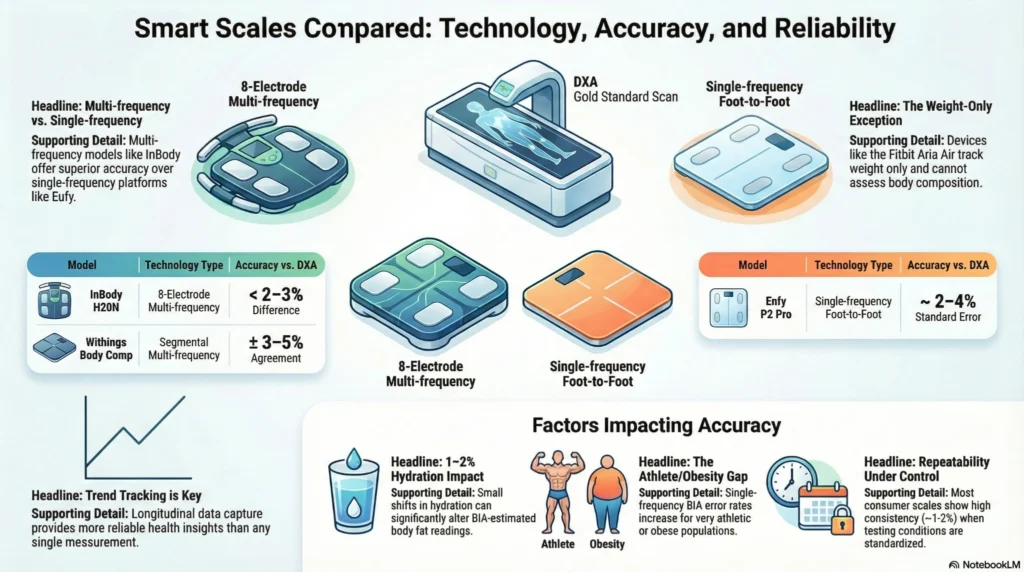
Smart scales promise detailed metrics, but are they useful?
Know What BIA Can and Cannot Measure
Most smart scales use foot-only BIA, estimating body fat percentage, muscle mass, water weight, bone mass, visceral fat, BMR, and metabolic age. More advanced models, such as the RunStar FG2305, use hand plus foot electrodes for better full-body analysis.
None are medically accurate. Hydration, food intake, and exercise can swing readings by 5 to 10 percent in body fat. Use BIA to track trends, not absolute values. A steady drop in body fat percentage over weeks is meaningful even if the number is not perfect.
Special Modes for Specific Needs
Baby mode lets you zero out a parent’s weight, then hold an infant to get their reading. Pregnancy or zero-current mode disables the BIA current and is safe for expecting mothers. Athlete mode adjusts algorithms for high muscle mass. Guest mode prevents data logging.
These features are must-haves if you have infants, are pregnant, or are a serious athlete.
Power, Design, and Usability
The little details make a big difference in daily use.
Battery Life and Power
Most scales use 2 to 4 AAA batteries. Some include batteries, such as the FitIndex. Auto-off preserves battery. Low-battery indicators warn before failure. Models like the RunStar D550 are designed for low power consumption, lasting years on one set.
Units and Display Options
Look for dual-unit support, including pounds, kilograms, and stones, which is common in UK models such as the RENPHO Elis 1.
Display types include LED for bright and easy reading, LCD with backlight for common and functional use, and TFT color for full-color screens such as on the RunStar FG2305. Some rare models offer dual analog plus digital display for aesthetic appeal.
Top Smart Scale Picks by Use Case

Not all smart scales are equal. Choose based on your goals.
Wyze X: Best Overall
The Wyze X offers 12 body composition metrics plus heart rate. It has an accuracy score of 9.1 out of 10 and consistency of 0.11 pounds. It syncs with Apple Health, Google Fit, and Fitbit. It uses 4 AAA batteries.
Pros include full-surface sensor, compact design, and precision. Cons include requiring bare feet and the possibility that large feet may hang off the platform.
FitIndex: Best for Families
FitIndex offers unlimited users and baby mode. It syncs with Apple Watch and Fitbit. It provides 13 body metrics. It uses 3 AAA batteries, which are included.
This is ideal for multi-user households.
Withings Body+: Best App Integration
The Withings Body Plus syncs with over 100 health apps. It tracks nutrition, weather, and goals. It has a sleek design. It uses 4 AAA batteries.
This is best for users deeply embedded in Apple or Samsung ecosystems.
Renpho Elis 1: Best for Goal Tracking
The Renpho Elis 1 offers goal setting and motivational insights. It includes baby mode and stone units. It comes with an app-connected tape measure.
This is perfect for weight loss journeys.
RunStar FG2305: Best for Athletes
The RunStar FG2305 provides 28 metrics via hand plus foot BIA. It has athlete mode and 24 user profiles. It features a full-color TFT display with real-time comparison. It has a large 13-inch platform.
This is the most data-rich option, ideal for serious fitness tracking.
Make the Final Decision
Choosing the right scale comes down to aligning features with your goals.
Follow This 8-Step Checklist
Define your goal. Just weight, body fat, or family use? Choose type. Digital for accurate, Smart for trends, Mechanical for simple. Verify accuracy. Look for tested consistency under 0.3 pounds is excellent. Check capacity. Ensure it supports the heaviest user. Test app compatibility. Must sync with your health platform. Review special features. Baby mode, athlete mode, zero-current. Assess design. Size, display, battery, carpet feet. Time your purchase. January offers the best deals.
Wait for New Year sales. Fitness demand drives discounts on smart and digital scales.
Key Takeaways for Choosing Your Bathroom Scale
The best bathroom scale is not the fanciest. It is the one you use consistently and trust. For most people, a high-accuracy digital scale like the Etekcity EB9380H is the smart starting point. If you want deeper insights, a smart scale like Wyze X or FitIndex adds value as long as you understand its limits.
Weight accuracy is reliable on digital and smart scales. Body composition is an estimate, so use it for trends, not truth. Consistency beats precision. Weigh at the same time, same way, every day. Integration matters. Your scale should fit into your health ecosystem.
By focusing on accuracy, usability, and your personal goals, you will choose a scale that does not just sit on the floor. It becomes a trusted tool for long-term health.
Frequently Asked Questions About Choosing a Bathroom Scale
What is the most accurate type of bathroom scale?
Digital scales are the most accurate for weight measurement. They use load cell sensors to provide readings down to 0.1 pound, making them far more precise than mechanical analog models. Smart scales offer the same weight accuracy as digital scales but add body composition estimates that are not medically accurate.
Do smart scales really measure body fat?
Smart scales use bioelectrical impedance analysis to estimate body fat percentage, but these readings are estimates, not precise measurements. Consumer Reports testing found smart scale body fat readings off by 21 to 34 percent compared to DEXA scans. Use these numbers to track trends over time rather than relying on absolute values.
How often should I replace my bathroom scale?
Replace your bathroom scale when you notice inconsistent readings despite proper use, if the display becomes difficult to read, or after several years of heavy use. Digital scales typically last 3 to 5 years with regular battery changes. Mechanical scales can last longer but may drift over time.
Can I use a bathroom scale on carpet?
Most bathroom scales require a hard, flat surface for accurate readings. Using a scale on carpet causes instability and inaccurate measurements. Some models include carpet feet that adjust for soft surfaces, but for best results, always weigh on tile, hardwood, or concrete.
What features do I need for family use?
For family use, look for a smart scale with multi-user support and automatic user recognition. Baby mode is essential if you have infants. Pregnancy mode with zero-current setting is important for expecting mothers. Verify the number of app profiles matches your household size.