Imagine perfectly risen sourdough, consistent coffee brews, or meal-prepped lunches with exact macros all made possible by one small but powerful tool: a kitchen scale. Whether you’re a casual cook or a precision-driven baker, knowing how to choose a kitchen scale can elevate your results and save time. The right scale ensures accuracy, fits your workflow, and withstands daily use. With so many models offering different features, from tare functions to smart nutrition tracking, it is easy to overspend on extras you do not need.
This guide cuts through the noise using real testing data and user insights to help you pick the best kitchen scale for your needs, budget, and cooking style. We will walk through the key factors that matter most: accuracy, capacity, materials, display usability, and special features.
Define Your Primary Use Case
Start by identifying how you plan to use your kitchen scale. Matching the tool to your routine prevents wasted money and frustration.
Cooking and Baking at Home
For everyday recipes, you need a scale that is reliable, easy to read, and supports basic functions like tare and unit switching. Most home cooks benefit from a digital model with a 5 to 10 kg capacity and a platform large enough for mixing bowls. Accuracy down to 1 gram is helpful but not critical unless baking bread or pastries.
Pro Tip: If you follow international recipes, ensure the scale switches between grams, ounces, pounds, and kilograms seamlessly.
Meal Prepping and Portion Control
Tracking calories or macros requires higher precision and longer auto-on times. Look for models with:
– High readability (0.1 to 1 g increments)
– Extended display time (5 plus minutes)
– Flat, easy-to-clean surfaces
Scales like the AENO KS1S offer nutritional tracking, letting you log food and view daily intake reports, ideal for fitness-focused users.
Coffee or Tea Brewing
Baristas and tea lovers benefit from scales with built-in timers and “coffee mode” that tracks brew time and water-to-coffee ratios. These models help optimize extraction and consistency. The AENO KS1S excels here with real-time feedback based on brewing method (pour-over, French press).
Commercial or High-Volume Use
If you are preparing large batches or running a food business, prioritize:
– High capacity (10 to 20 kg)
– Durable materials (stainless steel or reinforced glass)
– Easy cleanability and waterproofing
Avoid plastic-bodied scales in heavy-use environments. They wear out faster and trap debris.
Prioritize Accuracy and Reliability
:max_bytes(150000):strip_icc()/sea-kitchen-scales-test-primary-ashlee-redger-30_crop-dfaaae0db8bd442a8e279cd56074a98a.jpeg)
Accuracy matters most in baking and nutrition tracking, where small deviations affect outcomes.
Test Results: Which Scales Are Most Accurate
Based on expert testing across multiple conditions:
– Escali Primo: Only model to consistently measure 1 g accurately at all positions (center, edges, corners)
– OXO Good Grips: Accurate from 2 g upward, misses 1 g but reliable otherwise
– Zwilling Enfinigy and KitchenAid (small platform): Accurate above 2 g
– Ultrean and Amazon Basics: Frequently off by 1 to 2 g, especially under 10 g, not recommended for precision work
Reality Check: For most recipes, plus or minus 1 g variance will not ruin a dish. Functional reliability often outweighs marginal accuracy gains.
What Real-World Testing Reveals
Scales were tested under stress:
– 30 drops from 2 inches (simulating drawer drops)
– 200 button presses
– Rapid weight changes and uneven surface placement
The Escali Primo and OXO Good Grips maintained accuracy post-stress, proof of durability.
Match Capacity and Platform Size to Your Needs

Your container size should dictate platform dimensions and max weight.
Standard vs. High-Capacity Models
- Standard (5 to 10 kg): Ideal for home use. Handles mixing bowls, roasts, and dough.
- High-Capacity (10 to 20 kg): Better for large families or commercial prep.
KitchenAid Dual-Platform offers both bulk and precision weighing but has a flaw: its large platform reads 1 g low consistently.
Platform Design Matters
- OXO Good Grips: Features a removable platform, making cleanup easier.
- AENO KS1S: 8 kg capacity with a spacious glass surface, great for versatility.
- Pocket Scales (1 kg or less): Best for travel, spices, or supplements. Not suitable for general cooking.
Visual Cue: If your bowl overhangs the edges, the reading may be unstable. Always center the container.
Choose Easy-to-Clean, Durable Materials
Kitchen scales get messy: flour, oil, and sticky residues demand smart material choices.
Best Materials for Hygiene and Longevity
- Tempered Glass: Smooth, non-porous, easy to wipe. Can crack if dropped.
- Stainless Steel: Durable, resists corrosion. Shows fingerprints.
- Plastic: Lightweight, affordable. Traps grime in seams, degrades over time.
- Hybrid (Glass plus Metal Frame): Combines strength and sleek look. Varies by brand.
Cleanability: Real-World Findings
- Zwilling Enfinigy: Flat glass with no seams, flour wipes right off.
- OXO Good Grips: Laminated buttons and removable platform prevent buildup.
- Escali Primo: Seamless physical buttons resist moisture and flour.
- Ultrean and Amazon Basics: Gaps around buttons and base collect crumbs, hard to clean.
- Etekcity: IPX6-rated waterproof, can be rinsed under running water. Best for wet tasks.
Warning: Avoid scales with deep crevices or non-removable parts if you frequently weigh powders or sticky ingredients.
Ensure Clear Display and Intuitive Controls
A good scale should be easy to read and operate, even with wet hands or a full bowl in the way.
Backlit and Pull-Out Displays
- Backlit Screens (Ultrean, Etekcity): Essential in dim kitchens.
- Pull-Out Display (OXO Good Grips): Extends 4 inches, visible even when a large bowl blocks the front.
This feature is a game-changer for bakers using deep mixing bowls.
Auto-Off Time: Do Not Let It Shut Off Mid-Weighing
- Amazon Basics: Turns off after 2 minutes, too short for multi-step prep.
- Ultrean: 3 minutes.
- Escali Primo: 4.5 minutes.
- OXO Good Grips: Stays on for 30 minutes, best for long sessions.
Frustration Alert: A scale that shuts off mid-recipe forces repeated tare resets.
Button Types: Physical vs. Touch Sensors
- Physical Buttons (Escali, OXO): Tactile, reliable, work with wet fingers.
- Touch Sensors (Zwilling, Etekcity): Sleek but less responsive. Zwilling’s front-edge sensor is easy to miss.
- Ultrean Quirk: Pressing the tare button briefly registers as weight, causing a jump in reading, annoying during precise additions.
Consider Power Source and Battery Life
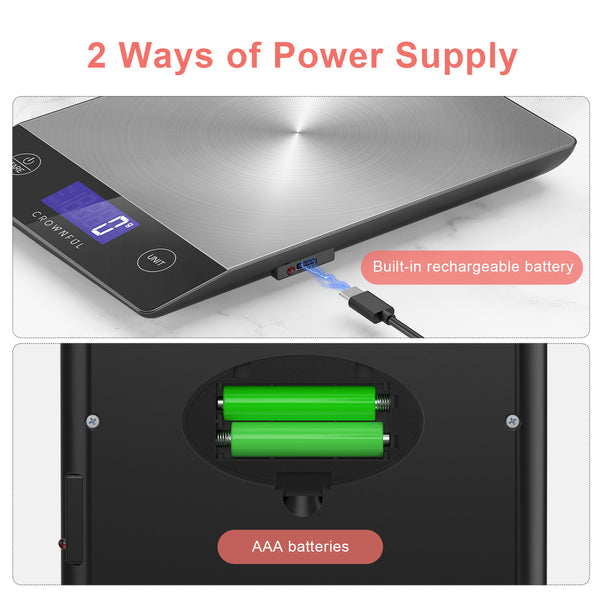
Power options affect convenience and long-term maintenance.
Battery-Powered vs. Rechargeable
- Battery-Powered (AAA/AA): Most common, easy to replace. Found in Escali, OXO, Amazon Basics.
-
Downside: No low-battery indicator on some models (e.g., OXO), so sudden shutdowns can occur.
-
Rechargeable (USB): Found in Zwilling Enfinigy and Etekcity.
- Zwilling Bonus: Includes a wireless phone-charging surface, convenient but risky near raw food.
Hygiene Note: Avoid placing phones or devices on the scale during cooking.
Auto-off settings help conserve power, but overly aggressive cutoffs (like Amazon Basics’ 2-minute rule) drain usability.
Decide If Smart Features Are Worth It
Advanced functions can be helpful, but only if you will actually use them.
Essential Features Worth Having
- Tare Function: Zero out container weight, standard on nearly all digital scales.
- Unit Switching: Toggle between grams, ounces, pounds, critical for global recipes.
- Hold Function (Etekcity): Freezes reading when view is blocked.
Niche Smart Features
- Sequential Weighing (AENO KS1S): Add multiple ingredients to one bowl, resetting after each.
- Liquid Volume Conversion: Estimates cups or ml from weight using density tables, handy for oils or milk.
- Nutrition Tracking: Input food name, scale calculates calories, carbs, protein.
- Daily Reports (AENO KS1S): Tracks macronutrient balance and micronutrient intake.
- Brew Timer and Coffee Mode: Tracks pour-over time and suggests ratios.
Reality Check: Most home cooks only need tare, unit switch, and clear display. Smart features shine for dieters, baristas, or tech lovers.
Top Kitchen Scales Compared
| Model | Price | Accuracy | Key Strengths | Weaknesses |
|---|---|---|---|---|
| Escali Primo | $15 to $25 | 1 g | Most accurate, durable buttons, 4.5-min auto-off | No backlight, plastic platform |
| OXO Good Grips | $30 to $40 | 2 g plus | Pull-out display, 30-min auto-off, removable plate | Misses 1 g, no battery indicator |
| Zwilling Enfinigy | $80 to $100 | 2 g plus | Rechargeable, flat glass, wireless charging | Poor button placement, touch sensor |
| Etekcity | $20 to $30 | plus or minus 1 to 2 g | IPX6 waterproof, LED backlight, hold function | Inconsistent readings |
| Amazon Basics | $10 to $15 | plus or minus 1 g | Affordable, stainless steel | 2-min auto-off, hard to clean |
| Ultrean | $10 to $12 | Inaccurate below 10 g | Cheap, backlit | Button acts as weight, fades fast |
| KitchenAid Dual-Platform | $40 to $50 | Large platform 1 g low | Dual platforms | Confusing display, hard to clean |
Expert Recommendations
Best Overall: OXO Good Grips
Why it wins: Combines practical design, long 30-minute auto-off, and pull-out display, perfect for real kitchens. The removable platform simplifies cleaning, and the build survives repeated drops.
While it misses 1 g, this does not impact most recipes. Ideal for cooks using large bowls and long prep sessions.
Best Budget Pick: Escali Primo
Delivers perfect 1 g accuracy at a low price. Durable laminated buttons and 4.5-minute auto-off make it reliable. Lacks backlight and premium feel, but excels where it counts.
Top choice for bakers who value precision over aesthetics.
Premium Pick: Zwilling Enfinigy
Sleek tempered glass and wireless phone charging stand out. Flat surface wipes clean easily. Rechargeable battery eliminates battery swaps.
But: Touch sensors are finicky, and the unit button is awkwardly placed on the bottom. Stylish, but usability lags.
Best for Wet Tasks: Etekcity (IPX6)
Fully water-resistant, can be rinsed under the tap. Bright LED display and hold function help when the bowl blocks the screen.
Accuracy varies by 1 to 2 g, so avoid for baking. Great for butchers, brewers, or messy prep stations.
Avoid for Precision: Ultrean and Amazon Basics
Both struggle below 10 g:
– Ultrean: Button press registers as weight, disrupts flow.
– Amazon Basics: Short 2-minute auto-off, gap traps crumbs.
Acceptable for casual use, but not for serious cooking.
Final Tips for Choosing the Right Kitchen Scale
Match the Scale to Your Workflow
Ask these questions:
– Do you use large bowls? Choose removable platform or pull-out display.
– Cook in low light? Need backlit screen.
– Prep for 20 plus minutes? Require long auto-off (10 plus min).
– Weigh sticky or wet ingredients? Pick waterproof or seamless design.
Do Not Overpay for Unused Features
Smart scales cost more but only help if you:
– Track calories daily
– Brew coffee seriously
– Add multiple ingredients in sequence
Otherwise, stick with core functions.
Accuracy Is Not Everything
For most dishes, plus or minus 1 g is fine. Focus instead on:
– Consistent performance
– Ease of cleaning
– Button reliability
– Display visibility
Check Long-Term Durability
Look for:
– Faded labels? (Ultrean fails here)
– Trapped flour? (Amazon Basics, poor design)
– Stuck buttons? (Touch sensors degrade over time)
Scales that survive drops and heavy use (like Escali and OXO) offer better long-term value.
Frequently Asked Questions About Choosing a Kitchen Scale
What is the most accurate kitchen scale for baking?
The Escali Primo is the most accurate model tested, consistently measuring 1 g correctly across all positions. It is the top choice for baking where precision matters.
How do I know if a kitchen scale has a good auto-off time?
Look for scales with auto-off times of at least 4 minutes. The OXO Good Grips stands out with a 30-minute auto-off, ideal for long cooking sessions.
Are smart kitchen scales worth the extra cost?
Smart scales are worth it only if you actively track nutrition, brew specialty coffee, or need sequential weighing. Most home cooks need only basic tare and unit-switching functions.
Which kitchen scale is easiest to clean?
Models with flat glass surfaces (Zwilling Enfinigy) and removable platforms (OXO Good Grips) clean easiest. Avoid scales with gaps around buttons or seams that trap flour and debris.
Can I use a kitchen scale for weighing liquids?
Yes, but only if the scale has a flat platform and good stability. For accurate liquid measurements, look for models with liquid volume conversion features.
What capacity kitchen scale do I need for home cooking?
A scale with 5 to 10 kg capacity handles most home cooking needs, including mixing bowls, roasts, and dough batches. Larger capacities (10 to 20 kg) are for commercial or large family use.
Key Takeaways for Choosing Your Kitchen Scale
The best kitchen scale fits your kitchen, not the other way around. You do not need every feature, just the right ones. Whether you are baking sourdough, tracking macros, or brewing coffee, the ideal scale makes the process smoother, cleaner, and more accurate.
Prioritize usability, durability, and real-world performance over specs on a box. For most home cooks, the OXO Good Grips offers the best balance of practical design and reliability. Budget-conscious bakers will find unmatched precision in the Escali Primo. Tech-savvy users may prefer smart features from models like the AENO KS1S, while those with wet or messy prep stations benefit from the Etekcity is IPX6 waterproof rating.
With the right choice, you will wonder how you ever cooked without it. Start with your workflow, match the features to your actual needs, and choose a scale that supports your cooking style for years to come.