Youre in a science class, and the teacher hands you a simple hanging scale with a coiled spring. You hook on a small weight, and the pointer moves, showing exactly how much it weighs. But how does a spring scale work? The answer lies in a 17th-century physics law that governs everything from car suspensions to bathroom scales: Hookes Law.
A spring scale measures force, typically the weight of an object due to gravity. Unlike digital scales that use electronic sensors, spring scales rely entirely on mechanical deformation, specifically how much a spring stretches when something pulls on it. Because this stretch is predictable and proportional to the applied force, it can be turned into an accurate reading. This article breaks down exactly how spring scales work, from the core physics principle to the internal gears, calibration, and real-world limitations.
Core Physics: Hookes Law Explained
At the heart of every spring scale is a simple but powerful equation: F = kx. This is Hookes Law, named after physicist Robert Hooke. It describes how elastic materials like metal springs behave under load.
What Each Variable Means
The key takeaway is that stretch is proportional to force. Double the weight, double the stretch, as long as the spring stays within its elastic limit.
- F represents the applied force, measured in newtons (N)
- k is the spring constant, a measure of the springs stiffness, expressed in N/m
- x is the displacement, the distance the spring stretches from its resting position
Why This Matters for Measurement
Because the relationship is linear, manufacturers can mark the scale with evenly spaced graduations. Each millimeter of stretch equals a specific amount of force. That is what makes it possible to turn physical movement into a readable number.
Warning: If you overload the spring and exceed its elastic limit, it will not return to its original shape. This ruins accuracy permanently.
Inside the Scale: Key Components
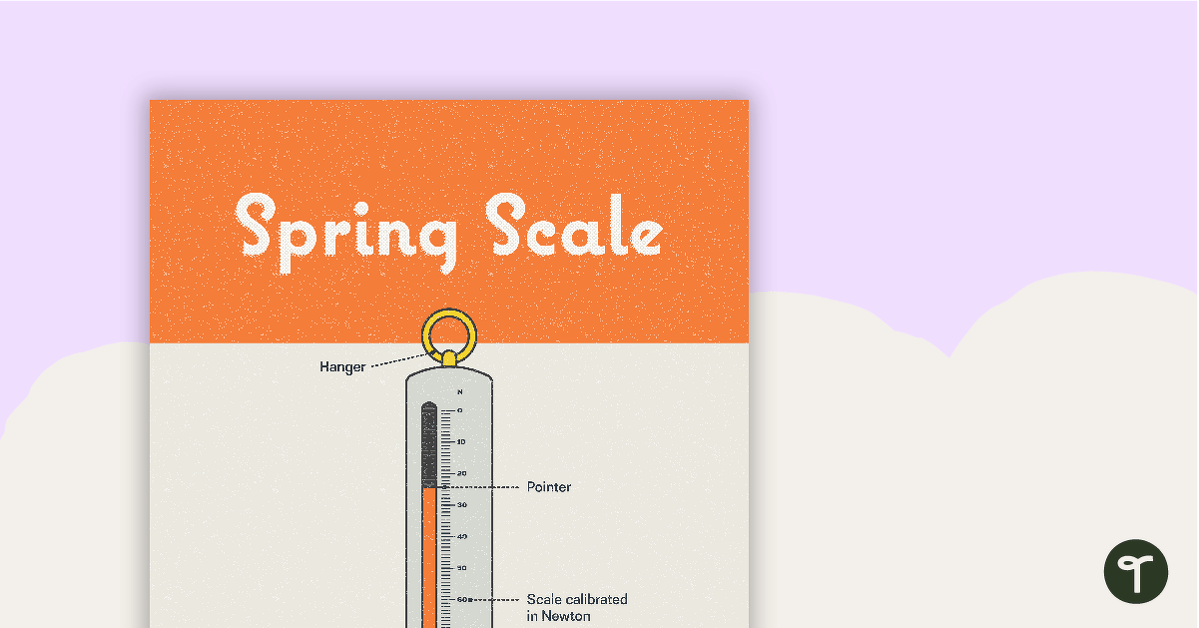
No matter the design, all mechanical spring scales contain the same essential parts working together to translate stretch into a number.
Main Spring: The Force Sensor
The main spring is the active component. When weight pulls down, the spring elongates. Its stiffness (k) determines how much it stretches per unit of weight, the scales range (light vs. heavy loads), and its sensitivity. Soft springs (low k) are used for precision in lab scales. Stiff springs (high k) handle body weight or industrial loads.
Rack and Pinion: Motion Translator
The rack and pinion system converts linear motion (spring stretch) into rotation. The rack is a toothed rod connected to the moving part of the spring. As the spring stretches, the rack moves down. It engages with the pinion gear, causing it to rotate. This gear movement drives either the pointer or the dial.
Pointer and Dial: The Readout
Two common configurations exist. Hanging scales feature a pointer that rotates over a fixed dial. Floor scales have a dial that rotates around a fixed pointer. Both achieve the same goal: showing weight through angular displacement.
Zero-Adjust Mechanism: Calibration Tool
A calibration knob or screw lets you reset the scale to zero with no load. This compensates for spring fatigue over time, dust or wear in moving parts, and added accessories like a weighing basket. Always zero the scale before use, otherwise every reading will be off by the same amount.
How Hanging Spring Scales Work
These are the classic classroom tools: a metal casing with a hook on top and bottom, and a circular dial.
Internal Design Breakdown
Hanging scales contain two main springs that stretch downward when weight is applied. The rack moves down with the load. A return spring keeps the rack engaged with the pinion gear. The pinion turns the pointer across a fixed dial.
Step-by-Step Operation
Follow this sequence when using a hanging spring scale.
- Hang the scale from a support
- Attach the object to the bottom hook
- Gravity pulls the object down, stretching the springs
- The rack moves downward with the spring extension
- Rack teeth turn the pinion gear
- Gear rotation moves the pointer across the dial
- Read the weight where the pointer stops
Calibration Process
Proper calibration ensures accurate readings.
- Remove all weight
- Check if the pointer reads zero
- If not, turn the zero-adjust knob until it aligns
- Recheck with a known test weight if possible
Pro Tip: Zero the scale after attaching any container or hook you plan to use.
Floor Spring Scales: Measuring Body Weight

Used in homes and clinics, floor scales look simple, but they rely on clever mechanics to measure heavier loads.
Structural Layout
The top platform (where you stand) connects to four support bars. These bars transfer your weight to a lever system. The lever presses down on the main spring. The springs compression (or extension) moves the rack. The pinion gear rotates the dial around a fixed pointer.
Why Leverage Is Key
Instead of stretching a spring directly, floor scales use levers to multiply force. This allows a relatively small spring movement to represent a large weight, making the scale compact and durable.
Weight Transfer Sequence
- Step onto the platform
- Your weight pushes down on support bars
- Bars press on a lever arm
- Lever amplifies force onto the spring
- Spring compresses, moving the rack
- Rack turns the pinion, rotating the dial
- Read weight at the pointer
Calibration Method
- Stand clear of the scale
- Locate the calibration dial at the base
- Rotate it until the dial reads zero
- Test with a known weight like a 10 kg dumbbell
Reading Your Spring Scale Correctly
Even a well-made spring scale gives wrong results if used improperly.
Avoid Parallax Error
Always position your eye level with the pointer. Viewing from above or below makes the reading appear higher or lower than it is.
Ensure Proper Positioning
Hanging scales must hang vertically. Tilt causes friction and inaccurate readings. Floor scales must sit on a hard, flat surface. Carpet or uneven floors absorb force.
Check for Zero Drift
Before every use, remove all load and confirm the pointer or dial reads zero. Adjust if necessary. Failure to do this introduces systematic error, every measurement will be offset.
Spring Stiffness and Scale Design
The spring constant (k) is crucial in determining a scales performance.
Soft vs. Stiff Springs
Designers choose k based on intended weight range, required precision, and durability needs. A kitchen scale might stretch 5 mm for 100 g. A 150 kg bathroom scale may move less than 1 cm across its entire range.
- Soft springs (low k) stretch significantly under small loads, ideal for light weights and high precision in lab measurements
- Stiff springs (high k) require greater force to produce measurable deformation, suitable for heavy loads like body weight
Critical Limitations of Spring Scales
Despite their simplicity, spring scales have important constraints.
Elastic Limit: The Point of No Return
Every spring has a maximum safe load. Exceed it, and the spring permanently deforms. It will not return to zero. Future readings become unreliable.
Never exceed the rated capacity, even briefly.
Overload Damage Signs
Watch for these warning signs. The pointer does not return to zero. Movement is sticking or jerky. Readings are inconsistent with the same weight. There is visible spring distortion. If any occur, the scale is likely damaged and needs replacement.
Environmental Factors
Temperature affects metal springs, which expand and contract with heat, altering k slightly. Corrosion increases friction and reduces spring life. Springs fatigue over time, especially with frequent use. Store scales in dry conditions and avoid harsh chemicals.
Force vs. Mass: What Are You Really Measuring?
This is a common source of confusion.
Spring Scales Measure Force (Weight)
They respond to gravitational pull, not mass. The reading is based on weight (W) = mass (m) × gravity (g). On Earth, g equals approximately 9.8 m/s², so a 1 kg mass weighs about 9.8 N.
Calibrated for Earths Gravity
Most spring scales are labeled in kilograms or pounds, but they are actually showing mass equivalents, assuming standard gravity. A 60 kg person weighs about 588 N on Earth, but only about 98 N on the Moon. The spring scale would show approximately 10 kg on the Moon, even though their mass is still 60 kg. So spring scales give incorrect mass readings in different gravities.
Real-World Applications
Spring scales remain useful across many fields due to their reliability and lack of power needs.
Educational Use
Teachers use spring scales for demonstrating Hookes Law in physics labs, measuring force in newtons, and comparing weight vs. mass.
Industrial and Commercial
These scales are perfect for weighing packages in shipping, checking produce in markets, and monitoring tension in cables or belts.
Household and Personal
Common applications include bathroom scales (floor type), luggage scales (hanging type), and kitchen scales (small spring mechanisms).
Field and Scientific
Spring scales excel in measuring pull force in mechanical systems, tension testing in ropes or wires, and portable weighing in remote areas. No batteries or electricity needed makes them ideal for outdoor or emergency use.
Best Practices for Accuracy and Longevity
To keep your spring scale working reliably, follow these guidelines.
Proper Care and Maintenance
Do zero the scale before each use. Do use within the rated capacity. Do store in a dry, room-temperature environment. Do clean gently, avoiding solvents. Do handle gently, no dropping or slamming.
Things to Avoid
Do not overload the scale. Do not expose to moisture or chemicals. Do not leave under constant load like hanging weights overnight. Do not use on soft or uneven surfaces.
Tip: Recalibrate monthly if used frequently.
Key Takeaways for Understanding Spring Scales
Spring scales work because of Hookes Law, which states that force equals spring constant times displacement (F = kx). This linear relationship between stretch and weight is what makes measurement possible.
The rack and pinion mechanism converts the springs linear stretch into rotational movement that drives the pointer or dial. Hanging scales use a moving pointer on a fixed dial, while floor scales use a rotating dial with a fixed pointer.
Always zero your scale before use to avoid systematic errors. Spring scales measure force (weight), not mass, so readings change with gravity. Overloading causes permanent damage, never exceed the rated limit.
Accuracy depends on proper technique: avoid parallax, ensure vertical or horizontal alignment, and stay within the elastic range. Regular calibration and proper maintenance extend the lifespan and reliability of your spring scale.
Frequently Asked Questions About Spring Scales
How does a spring scale measure weight?
A spring scale measures weight by using Hookes Law. When you hang a weight from the scale, gravity pulls the object down, stretching the spring. The amount of stretch is proportional to the force (weight) applied. This stretch moves a rack that turns a pinion gear, which rotates a pointer across a dial to show the measurement.
What is the difference between a hanging scale and a floor scale?
A hanging scale has a hook where you attach the object, and the pointer moves across a fixed dial. A floor scale has a platform you stand on, and the dial rotates around a fixed pointer. Both use the same原理 (principle) of spring deformation, but floor scales use levers to handle heavier loads.
Can a spring scale measure mass?
Spring scales actually measure force (weight), not mass directly. They are calibrated to display mass equivalents like kilograms or pounds, assuming standard Earth gravity. On the Moon or other planets with different gravity, the same scale would give incorrect mass readings.
How do I calibrate a spring scale?
To calibrate a hanging scale, hang it with no weight attached and turn the zero-adjust knob until the pointer reads zero. For floor scales, stand clear of the platform and rotate the calibration dial at the base until the reading shows zero. Always calibrate before first use and periodically thereafter.
Why does my spring scale give different readings each time?
This could indicate several problems. The spring may be damaged or fatigued from overloading. There could be debris affecting the rack and pinion mechanism. Temperature changes may have altered the spring constant. Try zeroing the scale first; if readings remain inconsistent, the scale likely needs repair or replacement.
What happens if you overload a spring scale?
Exceeding the rated capacity causes permanent damage. The spring will not return to its original length after being stretched beyond its elastic limit. This makes all future readings inaccurate. The pointer may not return to zero, and the scale may become completely unusable.