You step on a bathroom scale, place produce on a grocery scale, or weigh chemicals in a lab. Each time, you trust the number displayed. But how does a scale work? Behind that simple readout is a blend of physics, engineering, and digital intelligence. Whether mechanical or electronic, every scale translates physical force into measurable data. This guide breaks down the science behind different types of scales, revealing how they measure weight and mass using principles like Hooke’s Law, lever torque, and strain gauge resistance.
You’ll learn why some scales give consistent mass readings anywhere, while others vary by location. We’ll explore the inner workings of bathroom scales, kitchen devices, industrial weighbridges, and ultra-precise analytical balances. By the end, you’ll understand not just what a scale shows, but how it arrives at that number, what affects accuracy, and how to ensure reliable results.
Mechanical Spring Scales and Hooke’s Law
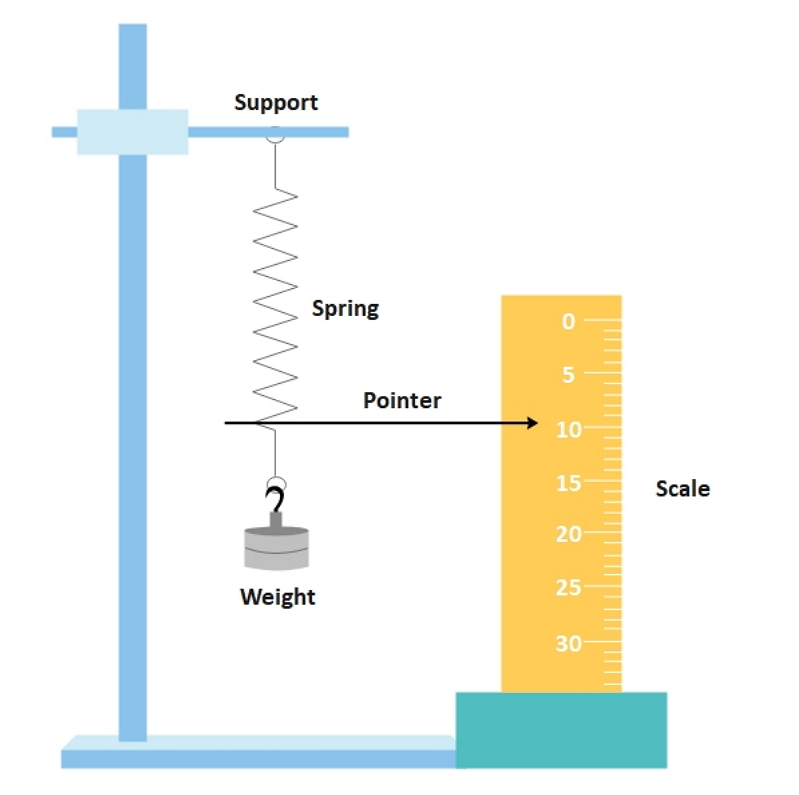
Spring scales are among the simplest and most widely used weighing devices. They measure weight, the force of gravity on mass, by detecting how much a spring stretches or compresses under load.
Hooke’s Law in Action
All spring scales rely on Hooke’s Law, which states that the force exerted by a spring is directly proportional to its displacement. The formula is F = kx, where F represents the applied force, k represents the spring constant (stiffness), and x represents the displacement. The more weight applied, the more the spring deforms within its elastic limit, creating a predictable movement that drives the scale’s reading.
A spring with a high stiffness constant requires more force to deform, while a flexible spring with a low constant deforms easily under small loads. Exceeding the elastic limit causes permanent deformation, breaking linearity and compromising accuracy.
How Hanging and Floor Spring Scales Work
A typical hanging scale uses two vertical springs connected to a rack-and-pinion mechanism. When a load pulls down on the hook, the springs stretch and the frame moves down, causing the rack gear to descend and turn a small pinion gear. This rotation moves the pointer across a calibrated dial to display the weight. A pull-spring keeps the rack and pinion engaged, ensuring smooth motion.
Floor-based mechanical bathroom scales use a compact internal system with four support bars that transfer weight to a central plate. Downward force activates a lever system that stretches a small central spring, moving a rack across a curved dial. A rotating dial with a fixed red pointer shows the weight, while a calibration ring at the base adjusts spring preload to align the dial with zero when no load is present.
Why Spring Scales Vary by Location
Since spring scales measure force rather than mass, they’re affected by local gravity. A 70 kg person weighs slightly less at the equator than at the poles due to Earth’s rotation and oblate shape. This can cause up to 0.5 percent variation globally. To ensure accuracy, calibrate the scale at its point of use, especially for legal or commercial weighing applications.
Balance Scales: Measuring True Mass

Unlike spring scales, balance scales compare masses and are unaffected by gravity variations. They provide consistent readings whether used on Earth, the Moon, or Mars, making them ideal for applications requiring true mass measurement.
Pan Balance and Equal-Arm Designs
The equal-arm balance is the oldest weighing method, using a beam with a fulcrum at the center and pans suspended from each arm. When you place an object on one pan and add known reference weights to the other, the beam levels when masses are equal. These scales date back to ancient Egypt around 2600 BC and were essential for trade in gold, grain, and spices.
The steelyard uses a single weight that slides along an off-center beam. An object hangs from the short arm while a poise (sliding weight) moves along the long arm. When balanced, the position indicates the mass. This design eliminates the need for multiple reference weights and was common in Roman and medieval trade.
Triple Beam and Roberval Balances
The triple beam balance, common in schools and labs, uses three movable poises on beams of different lengths. Each beam represents a unit such as 100g, 10g, and 1g. You slide poises until the pointer aligns with zero, then total mass equals the sum of poise positions. A zeroing screw adjusts the balance point when empty.
The Roberval balance, invented in 1669, uses a parallelogram linkage with two vertical columns connected by horizontal arms. This design keeps pans level regardless of load position, making it insensitive to off-center loading. It’s ideal for retail use but has lower precision due to friction from multiple pivots.
Torsion balances measure mass by twisting a wire or fiber. Weight causes the fiber to twist, and the degree of twist indicates mass. These scales can detect changes as small as 7 mg, making them suitable for pharmacy and microbalance applications.
Digital Scales: How Load Cells Work
Modern digital scales convert weight into electrical signals using load cells and strain gauges. This process is fast, accurate, and programmable, enabling features like tare, unit conversion, and Bluetooth connectivity.
The Load Cell and Strain Gauge System
A load cell is a metal block, typically made of steel or aluminum, engineered to bend slightly under load. One end is fixed to a stable base while the other supports the platform. When weight is applied, the cell deflects by fractions of a millimeter. Tiny strain gauges bonded to the surface stretch or compress with this deflection.
Strain gauges are resistive elements arranged in a zig-zag pattern to maximize sensitivity to deformation. When stretched, their resistance increases. When compressed, resistance decreases. Four gauges form a Wheatstone bridge circuit that is balanced at rest, producing zero output voltage. Under load, the imbalance creates a small millivolt signal proportional to the applied force.
Larger drilled holes in the load cell allow more flex and are used in low-capacity scales. Smaller holes result in higher capacity but less sensitivity.
Signal Processing and Display
The weak analog signal from the load cell must be amplified and converted to digital. The HX711 module performs three key functions. It amplifies the signal with programmable gain of 32x, 64x, or 128x. It converts via a 24-bit analog-to-digital converter, enabling gram-level precision. It sends digital data to a microcontroller for processing.
The microcontroller receives the digitized data, applies calibration values, compares to stored information to compute weight, and displays the result in selected units such as grams, ounces, pounds, or kilograms. Advanced models include tare, unit conversion, memory, and wireless connectivity for syncing with apps.
Electromagnetic Force Restoration in Lab Balances

Analytical and microbalances use a different principle called force restoration to achieve ultra-high precision. Instead of measuring deflection, these scales counteract the force to maintain equilibrium.
A coil floats in a permanent magnetic field. When mass is added, the pan starts to drop, but a feedback system increases current in the coil. The magnetic force pushes back, keeping the pan at a null position. The current required to maintain balance directly measures the mass.
This method offers accuracy down to 1 microgram, used in pharmaceuticals and research. Requirements include a draft shield to prevent air currents, room-temperature samples to avoid convection, and regular calibration with certified weights.
Specialized Scale Types and Applications
Different industries require specialized weighing solutions designed for specific environments and precision requirements.
Industrial scales include weighbridges for weighing trucks (using 4 to 8 load cells), forklift scales that weigh during lifting, pallet jack scales that combine transport and weighing, crane scales for suspended loads, and wheel loader scales with hydraulic sensors in buckets.
Smart bathroom scales use strain gauges under the platform and can measure body fat, muscle mass, and water percentage via bioelectrical impedance. They sync via Bluetooth or WiFi to health apps but require bare feet for conductivity.
Kitchen scales are compact and battery-powered with tare function to subtract container weight and unit conversion for grams, ounces, pounds, and milliliters. Supermarket scales print labels with weight, price, and total, and must be certified as Legal for Trade.
Factors That Affect Scale Accuracy
Multiple factors can impact the accuracy of your scale readings. Understanding these helps you achieve reliable measurements.
An uneven surface causes inconsistent readings. Always place your scale on a level, hard, flat surface and ensure all feet make contact with the ground. Off-center loading creates strain imbalance, so always center the object on the platform.
Temperature changes affect strain gauge resistance. Use temperature-compensated gauges and allow thermal stabilization before taking critical measurements. Dirt and debris under the scale feet prevent proper contact. Clean the base and platform regularly.
Dropping the scale damages load cells. Handle with care and avoid slamming objects onto the platform. Overloading permanently deforms springs or load cells. Never exceed the maximum capacity listed on your device.
Calibration and Maintenance Tips
Even the best scale drifts over time. Regular calibration ensures accurate readings and extends the device’s lifespan.
For calibration, power on the scale and wait for warm-up if required. Press Tare to zero the display. Place a certified weight in the center of the platform. Enter calibration mode and adjust until the display matches the known weight. Save the calibration factor to memory. Test with additional weights to verify linearity.
For maintenance, clean the scale regularly by wiping with a damp cloth and avoid letting liquids enter the housing. Avoid shocks by not dropping or slamming objects. Calibrate monthly or after any relocation. Store in a dry, stable environment when not in use. Replace batteries promptly because low voltage affects accuracy.
Digital vs Analog: Key Differences
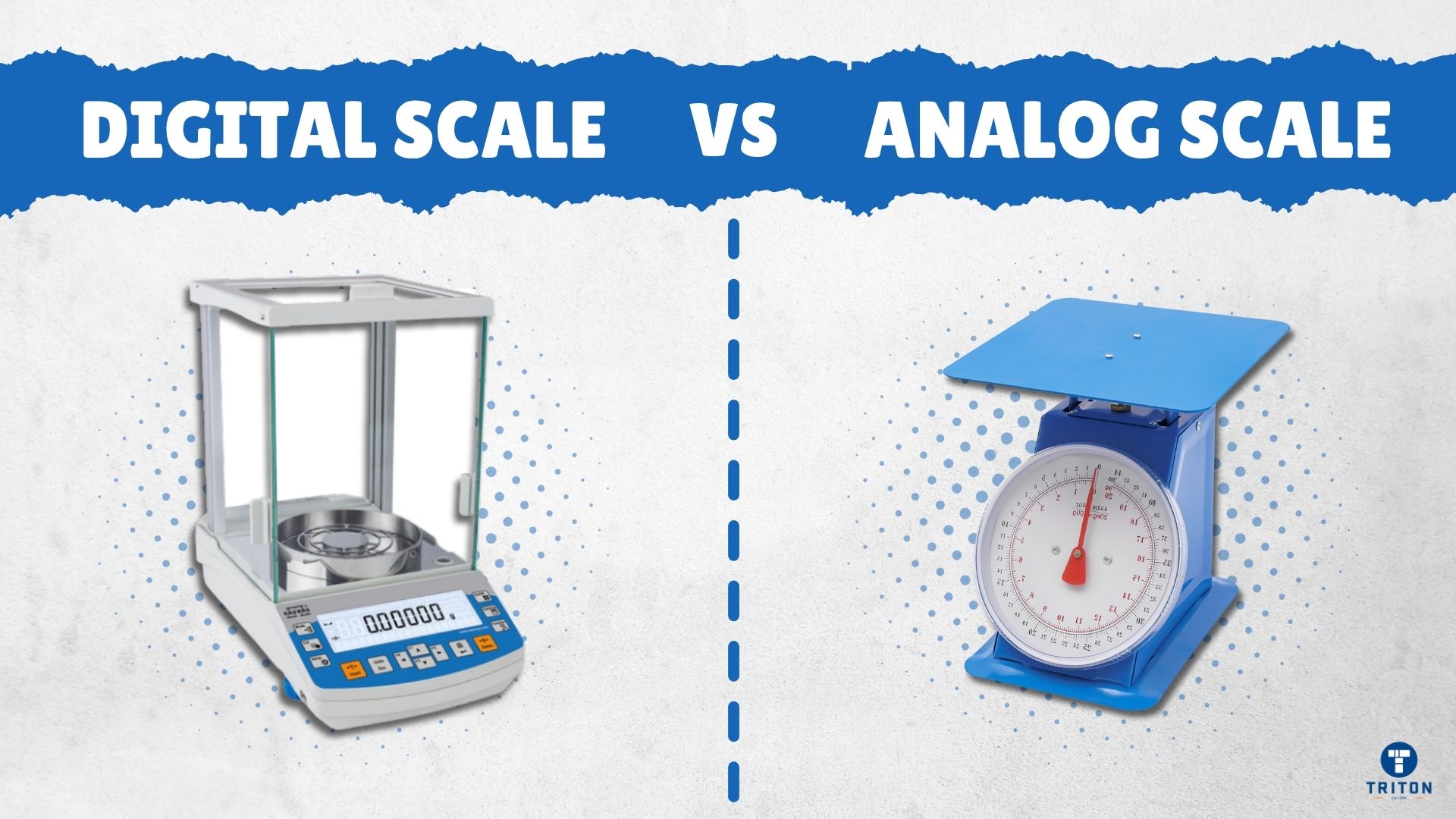
Digital and analog scales use fundamentally different technologies to measure weight, each with distinct advantages and limitations.
Digital scales use electronic load cells and microprocessors for measurement, displaying results on LCD or LED screens. They offer high accuracy (0.1g or better), multiple units, software-based calibration, and connectivity options like USB and Bluetooth. However, they require power (batteries or external), cost more initially, and contain fragile internal components.
Analog scales use mechanical spring deflection with dial-and-needle displays. They need no power source, cost less upfront, and are simple to operate. Limitations include lower precision due to parallax error, fixed measurement units, manual calibration adjustments, and no connectivity options.
Digital scales win for precision, automation, and data sharing, making them ideal for scientific, medical, and industrial applications. Analog scales remain useful for basic home or educational purposes where extreme precision isn’t required.
Frequently Asked Questions About How Scales Work
Does a scale measure weight or mass?
Most scales measure weight, which is the force of gravity on an object. They then convert this to a mass reading using standard gravity. Balance scales are the exception, as they compare masses directly and measure true mass regardless of gravitational differences.
Why do digital bathroom scales show different weights at different locations?
Digital scales measure force through load cells, so they’re affected by local gravity variations. A person may weigh slightly less at the equator than at the poles. Calibrate your scale at its location for accurate mass readings.
What is the most accurate type of scale?
Electromagnetic force restoration balances offer the highest precision, down to 1 microgram. These are used in analytical laboratories, pharmaceuticals, and research requiring extreme accuracy.
How often should I calibrate my digital scale?
Calibrate monthly for frequently used scales, after any impact or relocation, and before critical measurements. Use certified reference weights for calibration to ensure traceability.
Can I use any weight for calibration?
No. Use certified reference weights with known mass values traceable to national standards. Kitchen food weights or improvised objects lack the precision needed for accurate calibration.
Why does my scale show different readings when I place an object in different spots?
This indicates corner load error, typically caused by uneven load distribution across the strain gauges. Always place objects in the center of the platform for the most accurate reading.
Key Takeaways for Understanding How Scales Work
Scales work through several fundamental principles. Spring scales use Hooke’s Law (F = kx), where deformation directly relates to applied force. Balance scales compare masses and remain unaffected by gravity. Digital scales use load cells with strain gauges that change resistance when deformed, converting this to electrical signals processed by microcontrollers.
Accuracy depends heavily on proper use and maintenance. Always place scales on level surfaces, center your loads, calibrate regularly, and protect from temperature extremes and physical shocks. For true mass measurements unaffected by gravity variations, use balance scales rather than spring or digital force-based scales.
Understanding these mechanisms empowers you to select the right scale for your needs, operate it correctly, and maintain it for reliable results whether you’re tracking fitness progress, cooking with precision, or managing industrial inventory.