You are in the middle of baking, shipping a package, or meal-prepping on the road when you realize you have no way to measure weight. This is a common problem, but you can actually weigh stuff without a scale using everyday items and simple physics. From kitchen spoons to clothes hangers, coins to water displacement, this guide covers practical methods that deliver surprisingly accurate results. Whether you are measuring flour for cookies, estimating luggage weight, or teaching kids about mass, these strategies work anywhere without any special equipment.
The best part? You can achieve 5 to 10 percent accuracy using items already in your home. This is not about rough guessing. It is about reliable estimation through leverage, volume references, and basic physics. You will learn how to build a balance scale from a ruler, convert tablespoons to grams, and use your body weight to measure packages. Let us get started with real solutions that turn household items into precision tools.
Build a DIY Balance Scale From Household Items
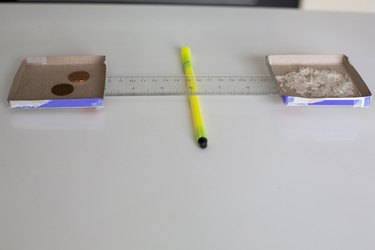
You can create a functional weighing tool using a ruler and pencil through the principle of torque balance. When two weights balance on a lever, their masses relate directly to their distances from the fulcrum. This method works for small to medium objects and delivers solid estimates with minimal materials.
Create a Ruler and Pencil Scale
You need a 12-inch ruler, a pencil, two identical cups, and some tape. Place the pencil horizontally on a flat surface as your fulcrum. Center the ruler over it at the 6-inch mark. Tape the ruler lightly so it stays in place but can still pivot freely. Attach lightweight containers like paper cups or bottle caps to each end using tape.
Test the setup with empty containers. The ruler should stay level. If it tilts, adjust the cups or add tiny counterweights like folded foil to balance it. Once stable, place your unknown object in one cup. Add known weights to the other cup until the ruler balances perfectly.
Pro tip: Use coins, sugar packets, or small food packages as reference weights. The more precise your known weight, the better your result.
Try the Hanger Balance Method
For heavier items like produce or small packages, use a wire clothes hanger. Hang it from a door hook or broomstick stretched between two chairs. Attach two equal-sized bags like plastic grocery bags to each end, ensuring they hang at the same length.
Place the object in one bag. Gradually add known weights like a 500 ml water bottle (500 g) or a 1 lb can of beans (454 g) to the other until the hanger hangs level. When balanced, the total known weight equals the unknown.
Visual cue: Look for horizontal alignment. If one side dips, that side is heavier.
Apply the Lever Equation for Accurate Results

The key to precise balance weighing lies in the lever equation: Weight₁ × Distance₁ = Weight₂ × Distance₂. When distances differ, you can calculate unknown weights even with a single known object. This turns your DIY scale into a scalable measurement system.
Calculate Weight Using Distance Ratios
Suppose you place a full soda can (12 oz or 340 g) 4 inches from the fulcrum. Your mystery object balances it at 10 inches. The ratio of distances is 10 ÷ 4 = 2.5. Since the unknown object is farther out, it must be lighter. Divide the known weight by the ratio: 12 oz ÷ 2.5 = 4.8 oz (136 g). So the object weighs 4.8 oz.
This technique lets you measure fractions of standard weights, perfect for small ingredients or jewelry.
Verify Results With Multiple Tests
Test consistency by reversing roles or using different known weights. For example, balance a Clif Bar (2.4 oz) against the same soda can. If the Clif Bar is at 14 inches and the can at 7 inches, the ratio is 2. Expected weight: 2.4 ÷ 2 = 1.2 oz, confirming the system works.
Warning: Friction, uneven containers, or air currents can skew results. Repeat tests and average outcomes for better accuracy.
Use Coins as Precision Reference Weights

Coins are among the most accurate household reference weights. Their minted mass is standardized and consistent, making them perfect for small-scale measurements.
Know Exact U.S. Coin Weights
| Coin | Weight |
|---|---|
| Penny (1¢) | 2.500 g |
| Nickel (5¢) | 5.000 g |
| Dime (10¢) | 2.268 g |
| Quarter (25¢) | 5.670 g |
These values are official U.S. Mint specifications. Even with minor wear, coins offer ±0.1 g reliability, better than most kitchen scales for tiny amounts.
Combine Coins for Common Weights
Ten pennies equal 25 g, matching approximately 1 tablespoon of butter. Four nickels equal 20 g, equaling 1 level tablespoon of sugar. Two quarters equal 11.34 g, close to a teaspoon of flour. Use them in your balance scale or compare by hand for quick estimates.
Pro tip: Keep a coin calibration kit in your kitchen drawer for quick checks.
Convert Volume to Weight for Cooking
In baking and cooking, volume measurements can substitute for weight when you follow proper technique. The key is consistency in how you fill and level containers.
Measure Flour Without Compaction Errors
Scooping flour directly from the bag packs it down, increasing weight by up to 25 percent. This can ruin cakes and breads. Use the fluff-spoon-level method. First, fluff the flour in its container with a fork. Second, spoon it gently into your measuring cup or spoon. Third, level the top with a straight edge like a knife.
Results include:
– 1 level tablespoon equals approximately 15 g
– 100 g equals approximately 6.7 tbsp (round up to 7)
Different flours vary in density:
– Cake flour: approximately 120 g per cup
– Bread flour: approximately 135 g per cup
Stick to spooned measurements for accuracy.
Estimate Sugar and Butter by Spoon
Granulated sugar is denser and more consistent than flour:
– 1 level tablespoon equals approximately 20 g
– 100 g equals 5 level tablespoons
For butter, U.S. sticks are pre-marked:
– 1 stick equals 8 tablespoons equals 113 g
– 1 tablespoon equals approximately 14 g
If your butter is soft, pack it into a spoon and level it. Or use the displacement method: drop it into a glass of water and measure how much the level rises. Each 1 ml increase equals approximately 1 g.
Weigh Liquids Using Simple Volume Conversions
For water, milk, oil, and similar liquids, 1 milliliter equals approximately 1 gram. This makes volume-to-weight conversion simple and highly accurate.
Use Spoons and Cups as Scales
These conversions work for water-based liquids:
– 1 teaspoon equals 5 ml equals approximately 5 g
– 1 tablespoon equals 15 ml equals approximately 15 g
– 1 cup equals 250 ml equals approximately 250 g
So 4 tablespoons of water equals 60 ml equals 60 g. No scale needed.
Adjust for Denser Liquids
Not all liquids weigh the same per ml:
| Liquid | 250 ml Equals |
|---|---|
| Milk | 258 g |
| Vegetable oil | 230 g |
| Honey | 355 g |
| Maple syrup | 333 g |
For most recipes, assuming 1 ml equals 1 g is close enough. But for precision tasks like candy making, account for density differences.
Quick hack: 2 tablespoons of honey equals approximately 43 g, about the weight of a standard chocolate bar.
Use Packaging and Everyday Objects as References
Many household items have known weights printed on them or are common enough to serve as reliable benchmarks.
Leverage Labeled Packages
Use pre-weighed goods as calibration tools:
– 1-liter water bottle equals 1,000 g
– 500 ml bottle equals 500 g
– Can of beans equals 454 g
– Bag of sugar equals 1 kg
Even snacks help:
– Hershey bar equals 43 g
– Sugar packet equals 4 g
– AA battery equals approximately 23 g
Keep one in your toolkit for impromptu weighing.
Compare by Feel to Common Items
When no tools are available, use tactile memory:
– Smartphone: 150 to 200 g
– Tennis ball: 57 g
– Baseball: 145 g
– Sheet of paper: 5 g
Lift the object and a reference item one after the other. Does it feel heavier than your phone? Lighter than a baseball? This method is subjective but useful for quick decisions.
Pro tip: Bundle known items. Four sticks of butter equals approximately 452 g, close to a pound.
Try the Water Displacement Method
For dense, non-porous solids like metal, stone, or fruit, use Archimedes principle: the volume of water displaced equals the object volume. For materials with density close to water, this also equals weight in grams.
Measure Displacement in a Graduated Container
First, fill a measuring cup with water and note the starting volume (for example, 200 ml). Second, submerge the object completely. Third, read the new volume (for example, 215 ml). Fourth, calculate the difference: 215 ml minus 200 ml equals 15 ml. This equals approximately 15 g estimated weight.
Limitation: Objects denser than water like iron will weigh more than their displaced volume suggests. Use this only for rough estimates.
Estimate Weight Using Your Body
When you have a bathroom scale but no way to weigh small packages, use the body weight differential method.
Weigh Yourself With and Without the Object
First, step on the scale alone and record your weight (for example, 70.0 kg). Second, hold the object and weigh again (for example, 72.3 kg). Third, subtract: 72.3 minus 70.0 equals 2.3 kg. That is the package weight.
Accuracy tip: Wear the same clothes, stand in the same spot, and avoid moving between readings. Repeat 2 to 3 times and average the results.
Warning: Most home scales lack precision below 500 g. This method works best for items over 1 kg.
Apply Methods to Real-World Situations
Each technique shines in specific situations. Match the method to your need for speed, accuracy, and available tools.
Bake Without a Scale
Use measuring spoons and cups with proper technique:
– Flour: fluff, spoon, level
– Sugar: level or packed as directed
– Butter: use stick markings or displacement
For 100 g flour, use 7 level tablespoons. For 100 g sugar, use 5 level tablespoons.
Avoid: Scooping flour directly from the bag. It adds excess and ruins texture.
Pack Luggage Without a Scale
Use the hanger method or body differential:
– Hang suitcase from a hanger setup with a 1-liter water bottle as counterweight
– Or weigh yourself, then yourself holding the bag
Most airlines allow 23 kg (50 lbs) for checked bags. Four 1-liter bottles equal 4 kg. Use as reference.
Ship Packages Accurately
Carriers charge based on weight. Undervaluing leads to postage adjustments plus fees.
Best methods include:
– Hanger balance with labeled cans or bottles
– Body weight differential
– Coin-based calibration for small envelopes
Rule: When in doubt, overestimate slightly to avoid surprise charges.
Teach Science With DIY Weighing
Turn this into a learning experience:
– Build a ruler scale to teach torque
– Use coins to explore mass and units
– Test water displacement with different objects
Challenge students to weigh a paperclip or raisin, developing precision and problem-solving skills.
Frequently Asked Questions About Weighing Without a Scale
Can I measure ingredients accurately without a kitchen scale?
Yes, you can measure ingredients accurately using measuring spoons and cups. The key is using proper technique. For flour, always fluff, spoon, and level rather than scooping directly from the bag. For sugar and butter, follow recipe instructions for heaping versus level measurements. Accuracy typically falls within 10 to 20 percent, which works for most recipes.
How accurate is a DIY balance scale?
A DIY balance scale using the lever equation can achieve 5 to 10 percent accuracy when constructed properly. The accuracy depends on several factors: how precisely you measure distances from the fulcrum, how level your setup remains, and how accurate your known reference weights are. Using coins or labeled packages as references improves precision significantly.
What household items weigh exactly 100 g?
Several common items weigh very close to 100 g. A small water bottle (100 ml) weighs exactly 100 g. A medium apple typically weighs 100 to 150 g. Four AA batteries equal approximately 92 g. A standard smartphone weighs 150 to 200 g, so half a phone is close to 100 g. You can also combine coins: 40 pennies (40 × 2.5 g) equal exactly 100 g.
Can I use water displacement for any object?
Water displacement works best for dense, non-porous objects that sink in water. It works well for metals, stones, fruits, and vegetables. It does not work accurately for porous objects like wood or sponges, which absorb water. It also does not work for objects less dense than water, which float. For these items, the displaced volume does not equal weight.
How do I weigh luggage without a scale for airline travel?
Use either the hanger balance method or the body weight differential method. For hanger balance, hang your suitcase from a clothes hanger suspended from a door hook. Add known weights (like 1-liter water bottles) to the other side until balanced. For body differential, weigh yourself alone, then weigh yourself holding the luggage, and subtract the difference. Most home scales are not precise below 500 g, so this works best for checked bags over 1 kg.
Key Takeaways for Weighing Stuff Without a Scale
You do not need a scale to weigh stuff accurately. With simple tools like rulers, coins, spoons, and everyday objects, you can estimate mass using physics, volume references, and known weights. The key is choosing the right method for your situation and applying proper technique consistently.
For cooking and baking, use the fluff-spoon-level method for flour and standard conversions for sugar, butter, and liquids. For shipping or luggage, build a hanger balance or use body weight differential. For small items, coins provide precision reference weights. For learning and experiments, leverage the lever equation with household items.
Remember these core principles: balance scales work through torque equilibrium, volume-to-weight conversions depend on proper technique, and reference objects like coins or labeled packages improve accuracy. With practice, you can estimate weight within 5 to 10 percent accuracy using only what you have around the house.