If you’ve ever wondered how big is 1:12 scale, the answer lies in a simple but powerful ratio: 1 inch on the model equals 1 foot (12 inches) in real life. This means every dimension, whether height, width, or depth, is shrunk to exactly 1/12th of the original. It is not just a number; it is a practical system that turns complex scaling into easy, intuitive measurements, especially if you use the imperial system.
For example, a 6-foot-tall person becomes 6 inches tall in 1:12 scale. A 12-foot ceiling in a real room translates to exactly 12 inches (1 foot) high in miniature. This direct conversion makes 1:12 one of the most user-friendly scales for modelers, dollhouse builders, and collectors. No calculators needed. You simply count the inches to know the feet.
This scale is widely used in dollhouses, action figures, die-cast vehicles, and architectural models because it strikes the perfect balance. It is large enough to include fine details like tiny books or working lights, yet small enough to display or store easily. From Queen Mary’s Dolls’ House at Windsor Castle to modern collectible figures from Hot Toys, 1:12 scale delivers realism and craftsmanship that smaller scales cannot match.
In this guide, you will learn how to convert real sizes to 1:12, see common object dimensions, compare it to other scales, and discover why so many artisans and collectors choose 1:12 for their most detailed work.
1:12 Scale Definition – The Simple 1-Inch-to-1-Foot Rule
One Inch Equals One Foot
In 1:12 scale, 1 inch on the model represents 12 inches (1 foot) in real life. This is the core principle that makes the scale both logical and easy to use. Whether you are measuring a table, a wall, or a ceiling, you simply take the real dimension in feet and convert it directly to inches in the model.
For example:
– A 7-foot door is 7 inches tall in 1:12.
– A 4-foot sofa is 4 inches long.
– A 30-inch side table (2.5 feet) becomes 2.5 inches high.
This direct relationship eliminates the need for fractions or complex math, making it ideal for quick planning and accurate construction.
Full-Size to Miniature Ratio
The 1:12 ratio means all three dimensions, length, width, and height, are reduced by a factor of 12. This applies equally whether you are building a house, a vehicle, or a human figure.
For instance:
– A 144-inch-long car (12 feet) becomes 12 inches long.
– A 96-inch-tall wardrobe (8 feet) becomes 8 inches high.
– A 60-inch-wide bed (5 feet) becomes 5 inches wide.
Because the scale is proportional, everything stays in harmony. Furniture fits under ceilings, people fit in chairs, and doors fit in walls, just like in real life.
Imperial vs Metric – How to Convert 1:12 Scale

Imperial Conversion Made Simple
The 1:12 scale is uniquely suited to the imperial measurement system, where inches and feet are standard. The rule is straightforward:
Model size in inches equals real size in feet
This mental shortcut allows instant scaling without formulas. Here is how common real-world sizes convert:
| Real Size | 1:12 Scale Equivalent |
|---|---|
| 5 feet | 5 inches |
| 5’6″ | 5.5 inches |
| 6 feet | 6 inches |
| 7’3″ | 7.25 inches (7¼”) |
| 8 feet | 8 inches |
| 10’6″ | 10.5 inches |
| 12 feet | 12 inches (1 foot) |
This makes sketching, building, and shopping for miniatures fast and accurate, especially when using a 1:12 scale ruler.
Metric Conversion Guidelines
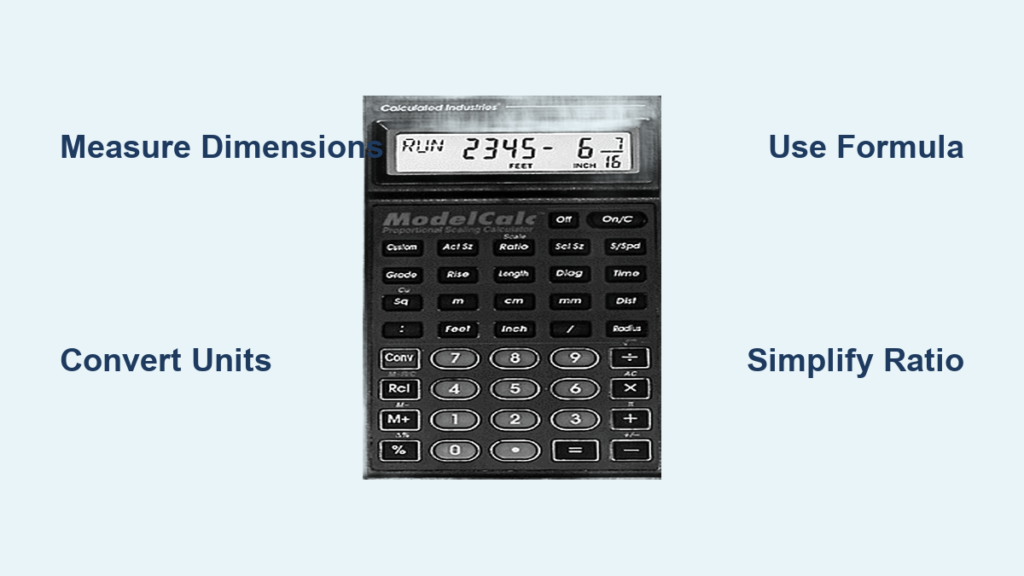
For metric users, the same 1:12 ratio applies, but requires basic math. You can divide real size (cm) by 12 to get model size, or multiply model size by 12 to get real size.
Example conversions:
– 180 cm person → 180 ÷ 12 = 15 cm (5.9 inches)
– 200 cm bed → 200 ÷ 12 ≈ 16.7 cm (6.5 inches)
– 240 cm table → 240 ÷ 12 = 20 cm (7.9 inches)
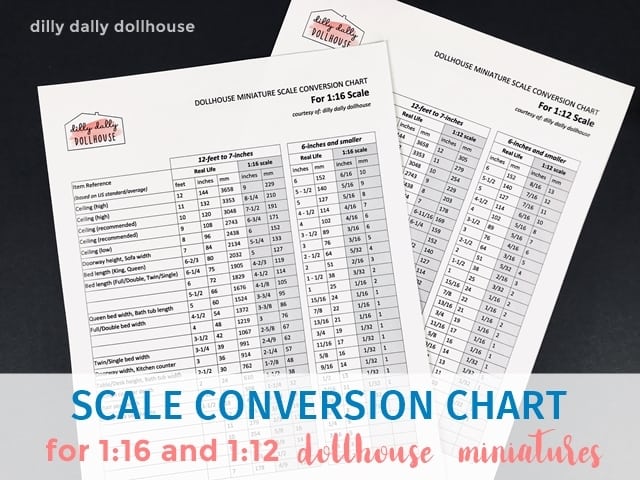
While not as intuitive as the inch-to-foot rule, a calculator or conversion chart makes it manageable.
Use a 1:12 Scale Ruler
Specialized 1:12 scale rulers are available to simplify design. These rulers are marked so that each inch represents 1 real foot, ¼-inch marks represent 3 inches in real life, ½-inch equals 6 inches, and ¾-inch equals 9 inches.
You can buy engraved acrylic or wooden rulers, or print and laminate your own using downloadable templates. These tools are essential for precision in miniature woodworking, interior design, and diorama building.
Human Figures – How Tall Are 1:12 Scale People?
Average Height in Miniature
In 1:12 scale, adult figures are typically 5 to 6 inches tall, matching real human heights:
– 5 feet tall = 5 inches
– 5’6″ = 5.5 inches
– 6 feet = 6 inches
– 5’2″ woman = 5.17 inches (approximately 5 1/6″)
These figures are used in dollhouses, dioramas, and retail displays to add life and scale. Porcelain, resin, and polymer clay are common materials, with brands like Little Women (UK) producing highly detailed models.
Meet George – The Standard Scale Reference
Meet George is a famous 6-inch porcelain gardener doll representing a 6-foot man in 1:12 scale. His female counterpart is 5.17 inches, standing for a 5’2″ woman. These figures are used by modelers to check furniture height, judge room proportions, and test if accessories look realistic.
Printable versions of George are widely shared online and can be cut out and laminated for use on workbenches or while shopping for miniatures.
Room Dimensions – How Big Is a 1:12 Scale Room?
Ceiling and Wall Height
Standard room heights in 1:12 scale reflect real architecture:
– 8-foot ceiling → 8 inches high
– 9-foot ceiling → 9 inches high
– 7-foot ceiling → 7 inches high
Walls are often built slightly shorter (for example, 7.5 inches for an 8-foot ceiling) to account for baseboards and moldings. This attention to detail enhances realism in high-end dollhouses.
Door and Window Sizes
Doors and windows follow proportional scaling:
– Standard door (7′ high) → 7 inches
– Door width (3′ wide) → 3 inches
– Window height (4’–5′) → 4–5 inches
– Wall thickness → 1/16″ to 1/8″ (represents 1″–1.5″ real)
These proportions ensure doors open properly, furniture fits through hallways, and interiors feel authentic.
Floor Space and Layout
A 12×12-foot room becomes 12×12 inches in 1:12 scale, small enough to fit on a desk, yet large enough to furnish realistically. This makes it ideal for room boxes, dioramas, and portable displays.
Even small spaces like closets or bathrooms (3×5 feet) become 3×5 inches, allowing for detailed fixtures and storage.
Furniture Sizes – What Fits in 1:12 Scale?
Standard Furniture Dimensions
Furniture is scaled to match 5–6 inch figures:
– Sofa: 4–5 inches long (4–5 feet real)
– Dining table: 3–4 inches long (3–4 feet)
– Bed: 6–7 inches long (6–7 feet)
– Chair: 3–3.5 inches tall (3.5–4 feet real)
– Coffee table: 2–3 inches long
Seat height should be just below the knee of a seated figure, about 0.5 inches from the floor.
Proportional Design Tips
To keep interiors realistic, table height should allow arms to rest naturally on the surface. Beds should be long enough to fully fit a figure lying down. Cabinets should align with wall and ceiling heights. Mirrors and art should be sized to fit walls without crowding.
Avoid “toy-like” oversizing. True finescale miniatures prioritize accuracy over convenience.
Common Uses – Where Is 1:12 Scale Used?
Dollhouses and Miniature Interiors
1:12 is the most popular scale for dollhouses, especially among adult collectors. It allows for working lights and plumbing, tiny books, food, and appliances, textured wallpaper, flooring, and curtains, and architectural details like crown molding and wainscoting.
The Queen’s Dolls’ House at Windsor Castle is a famous example, built in 1:12 scale with real electricity, running water, and miniature wine in the cellar.
Action Figures and Collectibles
High-end brands like Hot Toys and Sideshow Collectibles produce 1:12 scale action figures of superheroes, movie characters, and military personnel. These feature realistic body proportions, articulated joints, detailed costumes and accessories, and interchangeable hands and heads.
At 6 inches tall, they fit perfectly in dioramas or on shelves.
Die-Cast and RC Vehicles
1:12 scale cars, trucks, and motorcycles are larger than 1:18 or 1:24 models, allowing for more intricate paint and trim, functional parts like opening doors and suspension, higher detail in engines and interiors, and better performance in RC models.
These are prized by automotive and model car enthusiasts.
Live Steam Model Railways
While not used in tabletop railroads (HO or N scale dominate), 1:12 appears in miniature live steam railways, large, rideable models found in parks or private tracks. Their size supports functional boilers and engines, passenger transport, and structural durability.
They are engineering marvels, not toys.
Compare 1:12 to Other Scales
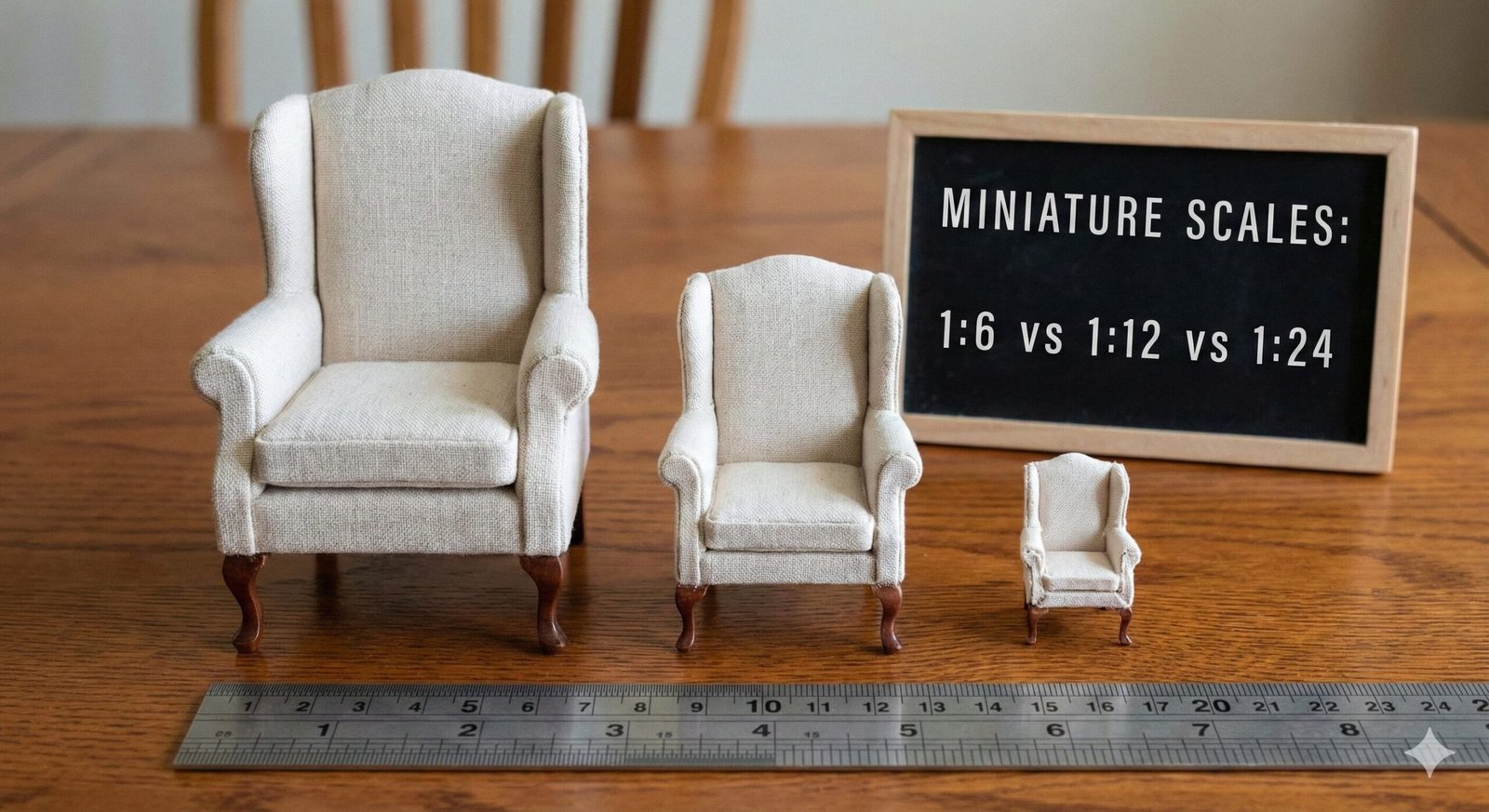
1:12 vs 1:6 Scale
- 1:6 is twice as big as 1:12
- A 6-inch figure in 1:12 becomes 12 inches in 1:6
- Used for fashion dolls (for example, G.I. Joe, Action Man)
- Requires double the space and materials
- Less common in interiors, more for display figures
1:12 vs 1:24 Scale
- 1:24 is half the size of 1:12
- A 6-inch person becomes 3 inches
- Used in smaller dollhouses or space-saving displays
- Less detail possible, but more rooms can fit in one case
1:12 vs Lundby (1:16)
- Lundby dollhouses use approximately 1:16 scale, slightly smaller than 1:12
- A 6-foot person equals approximately 4.5 inches tall
- Not interchangeable with 1:12 furniture
- Vintage Swedish sets require careful matching
Quick Scale Comparison Table
| Scale | Figure Height | Real-Life Match | Common Use |
|---|---|---|---|
| 1:12 | 5–6 inches | 5’–6′ person | Dollhouses, collectibles |
| 1:6 | 12 inches | 6′ person | Action figures |
| 1:24 | 3 inches | 6′ person | Mini dollhouses |
| 1:48 | 1.5 inches | 6′ person | Dioramas, model railroads |
| 1:16 (Lundby) | 4.5 inches | 6′ person | Vintage dollhouses |
| 1:87 (HO) | 0.8 inches | 6′ person | Model trains |
Crafting Tips – Working in 1:12 Scale
Converting 1:12 to 1:6 Scale
To enlarge a 1:12 design to 1:6, double all dimensions including length, width, and height. Then adjust material thickness. Boxy items like cabinets need double thickness for strength. Flat items like mirrors keep a single layer. Furniture like tables and chairs may use optional double layer for stability.
Example: A 1/16-inch thick wall in 1:12 becomes 1/8-inch in 1:6.
Material Limits by Tool
- Laser cutters can use 1/8″ plywood, which is ideal for 1:6 conversion.
- Cricut Maker is limited to 1/16″ basswood or 1.5mm chipboard. You must cut two identical pieces and glue them together for 1:6 thickness, which increases material use and cutting time.
Always test-fit before final assembly.
Why 1:12 Scale Is the Gold Standard
Advantages of 1:12 Scale
The 1:12 scale offers easy imperial conversion where 1 inch equals 1 foot. It provides optimal detail level, large enough for fine work. You get widely available supplies including kits, tools, and furniture. There is a strong collector community with tutorials, forums, and social media. It supports finescale compatibility for ultra-realistic builds.
Who Uses 1:12 Scale?
- Adult miniaturists focused on realism
- Artists creating narrative dioramas
- Educators teaching design or literature
- Model engineers building live steam trains
- Collectors of premium action figures
It is not just for kids. It is a serious hobby with artistic and technical depth.
Historical Context – From Gulliver to Modern Miniatures
Literary Precedent: Gulliver’s Travels
In Jonathan Swift’s 1726 novel, the Lilliputians are 1/12th the size of Gulliver, exactly matching the 1:12 ratio. This early example of scaled miniaturization shows how the concept has long fascinated people.
Standardization in the 1970s
Before the 1970s, miniature scales were inconsistent. Manufacturers used custom sizes. The rise of adult collecting led to demand for interchangeable parts, driving the adoption of 1:12 as the standard. Today, it is the benchmark for quality and compatibility.
Frequently Asked Questions About 1:12 Scale
What does 1:12 scale mean?
1:12 scale means that 1 inch on the model equals 12 inches (1 foot) in real life. Every dimension is reduced to exactly 1/12th of the original size.
How big is a 6-foot person in 1:12 scale?
A 6-foot person becomes 6 inches tall in 1:12 scale. This direct conversion is what makes 1:12 so intuitive for imperial measurements.
What is 1:12 scale in centimeters?
In 1:12 scale, 1 centimeter on the model equals 12 centimeters in real life. A 6-inch figure (15.24 cm) in 1:12 represents a 183 cm person.
Is 1:12 scale the same as 1:12 inch scale?
Yes. 1:12 scale is sometimes called “one-scale” or “1 inch scale” because 1 inch on the model equals 1 foot in reality. The terms refer to the same ratio.
What is the difference between 1:12 and 1:24 scale?
1:24 is half the size of 1:12. A 6-inch figure in 1:12 becomes 3 inches in 1:24. 1:24 is used for smaller dollhouses and space-saving displays.
Can 1:12 furniture fit in a Lundby dollhouse?
No. Lundby dollhouses use approximately 1:16 scale, which is smaller than 1:12. A 6-foot person in 1:16 is about 4.5 inches tall. Furniture is not interchangeable between these scales.
Key Takeaways for Understanding 1:12 Scale
The 1:12 scale is the gold standard in the miniature world because it offers the perfect balance between size and detail. The imperial conversion is straightforward, 1 inch equals 1 foot, making it accessible for hobbyists and professionals alike. This scale is widely used in dollhouses, action figures, die-cast vehicles, and architectural models, with a strong community and abundant resources available.
Whether you are building a detailed dollhouse, collecting premium action figures, or creating a diorama, understanding how big 1:12 scale is gives you the foundation to create miniature worlds that feel truly alive. The scale’s historical roots, dating back to Gulliver’s Travels, and its standardization in the 1970s have made it the most reliable and versatile choice for serious miniaturists and hobbyists worldwide.