Selling standing timber without knowing its true volume is like auctioning a car without checking the odometer. You risk leaving thousands of dollars on the table. Timber scaling is the process of estimating usable wood volume in live trees before harvest, and it directly determines the fair stumpage price you should receive. Studies consistently show that landowners who use professional assessments or accurate self-measurement techniques earn significantly higher returns.
This guide covers exactly how to scale standing timber, from essential field measurements like diameter at breast height and merchantable height to volume estimation using log rules like Doyle, Scribner, and International 1/4-inch. You will learn practical methods, see real-world volume tables, and understand how to adjust for defects so you get paid what your trees are worth.
Measure DBH at 4.5 Feet Above Ground
Diameter at Breast Height, or DBH, is the foundation of every timber calculation. This standardized measurement is taken exactly 4.5 feet above ground level on the uphill side of the tree when working on slopes. This specific height allows consistent comparisons across forests and markets.
Tools for Accurate DBH Measurement
You have several options for measuring DBH accurately. A diameter tape, also called a D-tape, wraps directly around the trunk and reads in inches, making it the most accurate option. If you only have a standard measuring tape, measure the circumference and divide by 3.14 to get diameter. For example, a 64-inch circumference equals approximately 20.38 inches DBH. Tree calipers work well for irregular stems when you take two perpendicular readings and average them. Biltmore sticks provide quick estimates but should be verified with a D-tape on sample trees.
Handling Tricky Trunk Shapes
Certain trunk conditions require specific protocols. When a bulge exists at 4.5 feet, measure above where normal form resumes. For trees that fork below 4.5 feet, treat each stem as a separate tree and measure each at 3.5 feet above the fork. If the fork occurs at or above 4.5 feet, measure just below the fork. For leaning trees, measure perpendicular to the trunk axis, and always keep your tape horizontal and taut.
Estimate Merchantable Height in Logs
Merchantable height determines how many usable logs can be cut from a tree. It starts at 1 foot above ground to account for the stump and ends where the trunk diameter inside bark drops to 8 to 10 inches for sawlogs, or 5 inches for pulpwood. Defects like rot, crooks, large knots, or epicormic sprouts also shorten usable length.
Round Down to the Nearest Half-Log
Height is recorded in 16-foot logs and 8-foot half-logs, and you always round down regardless of actual measurement. A tree measuring 42 feet contains 2 full logs plus an 8-foot half-log with 2 feet leftover, recording as 2.5 logs. A 46-foot tree still records as 2.5 logs. A 48-foot tree equals exactly 3.0 logs. The top limit ultimately depends on local mill specifications, so confirm with your buyer before scaling.
Use a Merritt Stick or Clinometer for Height
Two primary tools estimate merchantable height in the field. The Merritt hypsometer, often built into a Biltmore stick, estimates height quickly at a fixed distance.
Merritt Stick Method
Pace 66 feet from the tree, which equals 1 chain. Hold the stick vertically 25 inches from one eye with the zero end down. Align the base with the 1-foot stump mark on the trunk. Without moving your head, sight to the top of usable wood and read the number of 16-foot logs on the scale. This method assumes level ground and clear sightlines, making it ideal for quick cruising in hardwood stands.
Clinometer Method for Slopes
Clinometers measure angles to calculate height, making them superior on hills or uneven terrain. Stand at a known distance of 50, 66, or 100 feet from the tree. Sight to the bottom of the merchantable stem at 1 foot above ground and record the percentage reading. Sight to the top of the usable section and record the second percentage. Calculate height using the formula: Height equals the percentage difference divided by 100, multiplied by distance.
If one reading falls below eye level, add the absolute values together. For example, an upper reading of positive 36% and a lower reading of negative 4% calculates as 36 plus 4, divided by 100, multiplied by 66, equaling 26.4 feet. At 100 feet distance, the percentage difference directly equals feet of height. At 66 feet, multiply the percentage sum by 0.66. At 50 feet, divide the percentage sum by 2.
Choose the Right Log Rule for Volume Calculation
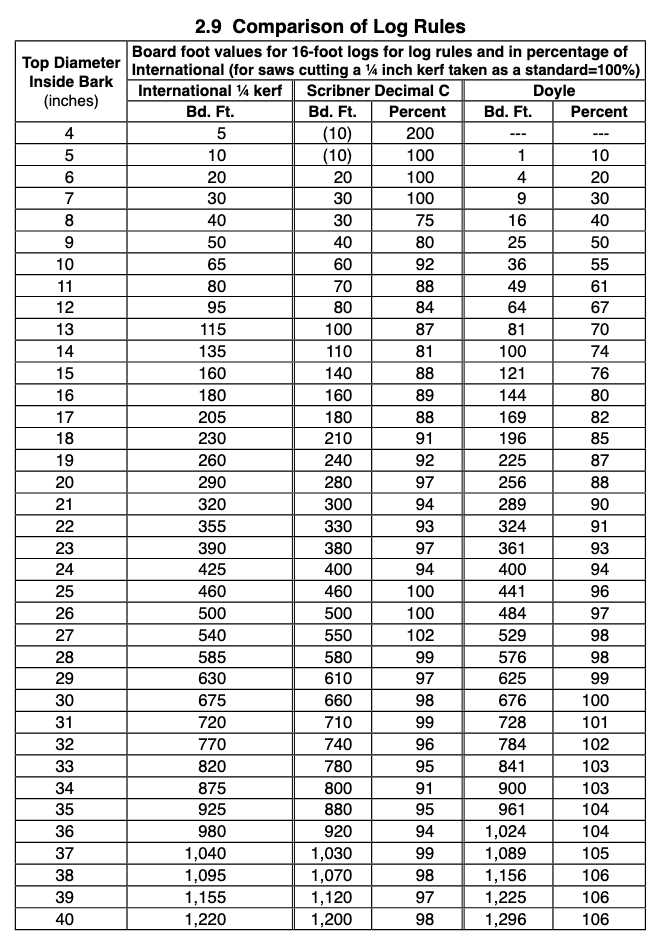
Board foot volume depends heavily on which log rule you use. Buyers and sellers must agree on the rule before the sale, as it directly impacts the calculated volume and final price.
Comparing the Three Major Log Rules
The Doyle rule is simple but underestimates small logs by 30 to 50%. It remains common in the Southeastern United States. The Scribner rule uses visual diagrams and accounts for the saw kerf. It sees widespread use in the Western United States. The International 1/4-inch rule is the most accurate predictor of actual yield. It accounts for taper, the 1/4-inch kerf, and realistic recovery. This rule is preferred for fair sales and federal or state contracts.
For a 16-inch diameter by 16-foot log, Doyle calculates 144 board feet, Scribner calculates approximately 169 board feet, and International calculates approximately 180 board feet. If selling under Doyle, understand that actual volume may be 40% higher. Always request International for transparent pricing.
Apply Volume Tables by DBH and Height

After measuring DBH and merchantable height, use volume tables to estimate total board feet. The tables below provide quick reference values for the two most common log rules.
Doyle Rule Volume Table
A 16-inch DBH tree with 1 log equals 40 board feet, 1.5 logs equals 70, 2 logs equals 100, 2.5 logs equals 120, 3 logs equals 140, and 4 logs equals 180. A 20-inch DBH tree with 1 log equals 80 board feet, 1.5 logs equals 130, 2 logs equals 180, 2.5 logs equals 220, 3 logs equals 260, and 4 logs equals 320. A 24-inch DBH tree with 2.5 logs equals 360 board feet, and 4 logs equals 540.
International 1/4-Inch Rule Volume Table
A 16-inch DBH tree with 2.5 logs equals 180 board feet. A 20-inch DBH tree with 2.5 logs equals 300 board feet. A 24-inch DBH tree with 2.5 logs equals 430 board feet. The same tree measured under Doyle yields only 220 board feet, an 80-board-foot difference that directly impacts your payment.
Adjust for Defects and Cull

Gross volume overestimates salable wood. Net volume subtracts losses from rot, splits, cracks, sweep, crook, fire scars, insect damage, and epicormic branching. Typical deductions range from 10% to 30% of gross volume.
Applying Cull Deductions
Light defects like small knots or minor sweep warrant 10% to 15% deduction. Moderate defects like interior rot or medium crook warrant approximately 20% deduction. Severe defects like extensive decay or major sweep warrant 30% or higher. A tree with 300 gross board feet minus 20% cull yields 240 net board feet. Some logs may be entirely rejected if defects make them unsalable.
Consider Species and Taper Differences
Not all trees scale the same, even with identical DBH and height. High-value hardwoods like black oak, red oak, white oak, black cherry, sugar maple, and American Beech have low taper, meaning they retain diameter longer and yield more volume per log. Fast-tapering softwoods like loblolly pine, Douglas fir, eastern red cedar, and white pine lose diameter quickly, reducing log count even in tall trees. Digital calculators apply species-specific taper models for better accuracy.
Run a Timber Cruise for Stand-Wide Estimates
For larger tracts, you do not need to measure every tree. Sample-based cruising methods provide accurate stand-wide estimates efficiently.
Common Cruising Methods
Plot sampling measures trees in fixed-area plots like 1/10th acre and works well in even-aged stands. Strip cruising measures all trees in narrow bands across the tract and suits open woodlands. Point sampling uses an angle gauge at fixed points to estimate basal area quickly. A homemade angle gauge with a 1-inch window on a 33-inch string means each counted tree represents 10 square feet of basal area per acre.
Verify Property Lines Before Scaling
Never scale or sell timber without confirming boundaries first. Locate property corners using surveyor flags, blazes, or iron bars. Hire a licensed surveyor if lines are unclear. Identify line trees on the boundary, which are owned jointly with adjacent landowners. Do not harvest line trees without written agreement from both property owners.
Use Digital Tools and Calculators
Modern apps and online tools speed up scaling with built-in species taper, log rules, and defect adjustments. These calculators input DBH, species, and merchantable height, then output board feet by Doyle, Scribner, and International rules with log-by-log breakdowns. Many include green and dry weight estimates and defect adjustment sliders. For pulpwood and biomass, scaling often shifts to weight since trucks are weighed at the mill. One cord of red oak equals approximately 5,500 pounds green weight.
Follow the Complete Scaling Workflow
Follow this step-by-step process to scale standing timber accurately. First, confirm property boundaries and mark line trees. Second, identify commercial species present. Third, measure DBH at 4.5 feet using D-tape or caliper. Fourth, estimate merchantable height in 16-foot logs. Fifth, use Merritt stick or clinometer and adjust for slope. Sixth, select your log rule, preferring International 1/4-inch. Seventh, look up volume in tables or use a digital calculator. Eighth, deduct 10% to 30% for defects. Ninth, multiply net volume by the stumpage rate. Tenth, document results with notes, photos, and GPS points.
For example, a 20-inch DBH tree with 2.5 logs under International rule equals 300 board feet. Minus 20% cull equals 240 net board feet. At $200 per thousand board feet, that single tree is worth $48.
Frequently Asked Questions About Scaling Standing Timber
What is the most accurate log rule for scaling standing timber?
The International 1/4-inch rule is the most accurate predictor of actual yield among commonly used log rules. It accounts for taper, the 1/4-inch saw kerf, and realistic lumber recovery. Most federal and state contracts require this rule, and it provides the fairest basis for negotiating stumpage prices.
How do I measure DBH on a tree with a fork near breast height?
If the fork occurs below 4.5 feet, treat each stem as a separate tree and measure each at 3.5 feet above the fork. If the fork occurs at or above 4.5 feet, measure the DBH just below the fork and treat it as one tree. One stem shorter than 8 feet may only qualify as firewood rather than a merchantable log.
What percentage should I deduct for defects when scaling timber?
Typical cull deductions range from 10% to 30% depending on defect severity. Light defects like small knots warrant 10% to 15%. Moderate defects like interior rot warrant about 20%. Severe defects like extensive decay warrant 30% or higher. Always inspect the actual tree when possible rather than applying blanket assumptions.
Can I scale standing timber myself, or do I need a professional?
You can learn to scale timber accurately using the methods in this guide. However, hiring a consulting forester provides independent verification and often pays for itself through higher sale prices. Foresters bring expertise, unbiased estimates, and contract negotiation skills that protect your interests and maximize value.
What is the difference between gross volume and net volume?
Gross volume is the estimated volume without deducting for defects. Net volume is gross volume minus deductions for rot, cracks, sweep, crook, and other defects that reduce salable lumber. Net volume always equals gross volume or less and represents the actual wood you can sell.
How do I determine merchantable height for a tree?
Merchantable height runs from 1 foot above ground to where the trunk diameter inside bark drops to 8 to 10 inches for sawlogs or 5 inches for pulpwood. Measure in 16-foot logs and 8-foot half-logs, always rounding down. Defects, branching, and taper also limit where usable wood ends.
Key Takeaways for Accurate Timber Scaling
Accurate timber scaling transforms guesswork into data-driven decisions that protect your financial interests. The two essential measurements are DBH at 4.5 feet and merchantable height in log units, and these form the foundation of every volume calculation. Your choice of log rule significantly impacts calculated volume, with International 1/4-inch providing the most accurate estimate while Doyle can understate actual yield by 40% or more.
Always deduct 10% to 30% for defects and cull, and verify property boundaries before scaling or selling any timber. Consider hiring a consulting forester for independent valuation, as studies consistently show landowners earn more than enough to cover their fees. Whether you use a D-tape and Merritt stick or a smartphone app, the principles remain the same: measure precisely, calculate fairly, and verify independently. Taking the time to scale standing timber correctly ensures you receive fair payment for your forest’s true value.