If you have ever wondered why your cookies turn out differently each time, the answer might be in how you are measuring ingredients. Learning how to read a kitchen scale is the simplest way to achieve consistent, professional-quality results, especially in baking where precision matters. Unlike measuring cups that gauge volume, a kitchen scale measures weight, eliminating guesswork caused by packing, scooping, or ingredient density. This guide walks you through exactly how to read and use your digital kitchen scale whether you are weighing flour, liquids, or spices.
Setting Up Your Kitchen Scale: Power On and Unit Selection
Before measuring anything, you need to set your scale correctly. Most digital kitchen scales support multiple units, and choosing the right one ensures accuracy for every recipe you try.
Choosing Between Grams, Ounces, or Pounds
Press the power button to activate the scale. Use the unit or mode button to switch between grams for precision, ounces for common U.S. recipes, or pounds for large batches. Always match the unit to your recipe. If it says 250 grams flour, set the scale to grams, not ounces.
Grams offer the finest control. Even a 1-gram difference can matter in delicate bakes like macarons or French pastries.
Avoid Confusing Fluid Ounces with Weight
Some scales display fluid ounces, which measure volume, not weight. Water is an exception where 8 fluid ounces equals 8 ounces by weight. But for dense liquids like honey or corn syrup, 8 fluid ounces does not equal 8 ounces by weight. It weighs significantly more.
Weigh all liquids in grams or ounces by weight, not fluid ounces, for true accuracy.
Using the Tare Function to Zero Your Scale
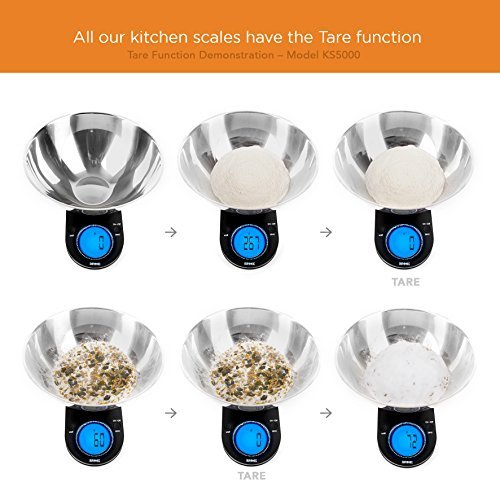
The tare function is the secret to using a kitchen scale efficiently. It resets the display to zero after placing a bowl or container, so you only measure what you add inside.
How to Tare Properly
Set your mixing bowl, pan, or plate on the scale. Wait for the weight to stabilize. Press tare and the display will show zero. Now any weight added is just the ingredient, not the container.
Forgetting to tare leads to over-measuring. Always zero out before adding ingredients.
Why Taring Saves Time and Dishes
You can add multiple ingredients to the same bowl without washing cups and spoons between each addition. This is perfect for one-bowl batters, doughs, and layered recipes. The tare function streamlines your entire cooking process.
Weighing Your First Ingredient Accurately
Now that your scale is zeroed, it is time to measure your first ingredient. Watching the display in real time helps you reach exact weights without overshooting.
Read the Display in Real Time
Slowly pour flour, sugar, or other ingredients into the bowl. Watch the numbers climb on the display. Stop when you reach the exact weight. Most scales update every 0.1 to 0.5 seconds, so pour slowly near the target to avoid going over.
What to Do If You Add Too Much
If you go over the target weight, remove excess with a spoon and recheck the weight. Do not tap the scale to reset. Let it stabilize naturally for accurate readings. Using a spatula helps scrape in the last bits without over-pouring.
Measuring Multiple Ingredients with Sequential Taring
After measuring one ingredient, you can continue adding others without transferring or cleaning between steps. Sequential taring is a game-changer for efficiency.
Sequential Weighing in One Bowl
After adding 100 grams of sugar, press tare again. The scale resets to zero, now ignoring both bowl and sugar. Add 150 grams of butter until the display reads 150 grams. Repeat the tare, add, tare, add process for each ingredient.
The scale subtracts everything already on it, so each new ingredient starts from zero.
When to Use Separate Bowls
Use separate bowls for dry versus wet ingredients, or when ingredients must stay dry, like yeast and water in sourdough. Place a new container on the scale, tare it, measure the ingredient, then combine as needed.
Weighing Dry and Liquid Ingredients Correctly
Not all ingredients behave the same on a scale. Knowing how to handle each type improves your results significantly.
Dry Ingredients: Fluff Before Weighing
Flour, sugar, cocoa powder, and oats compact easily. Always fluff or sift before scooping to avoid dense, heavy measurements. One cup all-purpose flour equals 120 to 125 grams. One cup of granulated sugar equals 200 grams. One cup of packed brown sugar equals 220 grams.
Your scoop style affects weight. For consistency, measure once and record your personal standard.
Liquids: Weigh Instead of Measuring by Volume
Place your bowl on the scale, tare it, then pour milk, oil, or syrup. Stop when you hit the target weight. There is no need for a separate liquid measuring cup. Avoid fluid ounces unless the recipe specifically requires volume measurement, because they do not reflect actual weight for thick liquids.
Small Amounts: Spices and Leaveners
For tiny quantities like 1/4 teaspoon salt, measuring spoons are still common. But for ultimate consistency, weigh even small ingredients. One teaspoon of baking powder weighs 4 to 5 grams. One teaspoon of salt weighs 5 to 6 grams. Use a small container or wax paper to avoid contaminating the main bowl.
Converting Cup Measurements to Weight

Many recipes still use cups, but you can easily adapt them using your scale. Converting ensures you get the same results every time.
How to Convert Your Own Recipes
Measure one cup of flour with your usual method. Place it on the scale and note the weight. Record this in your recipe. Use that number every time you make the recipe.
This method accounts for your personal scooping style and ensures reproducible results.
Quick Reference Conversion Guide
All-purpose flour: 120 to 125 grams per cup
Bread flour: 127 grams per cup
Granulated sugar: 200 grams per cup
Brown sugar, packed: 220 grams per cup
Butter: 113 grams per half cup
Rolled oats: 80 grams per cup
Chocolate chips: 170 grams per cup
These are averages. Always verify with your own scale for best accuracy.
Converting Between Grams and Ounces Easily
Understanding how to convert between units helps when using global recipes. Most modern recipes list both units for convenience.
Grams to Ounces: Simple Math
One ounce equals 28.35 grams. To convert, multiply ounces by 28.35. For example, 8 ounces of chocolate equals 226.8 grams, which you can round to 227 grams.
Use the Unit Button for Instant Switching
Most scales let you toggle between grams, ounces, and pounds with one button. There is no need to do mental math. Just press unit and keep pouring.
Pro Tips for Kitchen Scale Precision
Once you have mastered the basics, these techniques take your scaling game to the next level.
One-Bowl Mixing Method
This method is perfect for cakes, muffins, and cookie dough. Tare the bowl, add butter and tare, add sugar and tare, add eggs and tare, then add flour and leaveners together. The benefit is minimal cleanup, consistent blending, and faster prep.
Direct Weighing for Solids
For items like fruit, meat, or cheese, place food directly on the scale. Press tare first. Read the weight instantly. Switch units as needed for portioning.
Calibrate for Long-Term Accuracy
Over time, scales can drift. Test with a known weight. A U.S. nickel weighs 5 grams, so four nickels equal 20 grams. If inaccurate, consult the manual for calibration steps. Ensure the scale is on a flat, stable surface away from drafts or heat.
Fixing Common Kitchen Scale Problems
Even reliable scales can act up. Here is how to fix the most frequent problems.
Scale Will Not Turn On
Check the battery and replace if weak. Make sure the scale is on a hard, level surface. Some models auto-off after inactivity, so press power again if needed.
Display Jumps or Fluctuates
This is caused by vibrations, wind, or unsteady placement. Place the scale on a non-slip mat or cutting board. Close nearby windows or doors to reduce airflow.
Tare Function Does Not Work
Wait for the display to stabilize before pressing tare. Do not overload the scale beyond its capacity, which is usually 5 to 17 pounds. Clean the platform because debris can interfere with sensors.
Why Kitchen Scales Beat Measuring Cups
Switching to a kitchen scale is not just about precision. It changes how you cook entirely.
Accuracy You Cannot Get with Cups
One cup of flour can weigh 113 to 198 grams depending on how it is scooped. That is a 70 percent difference, enough to ruin a cake or bread. Weight-based measurement eliminates this variability completely.
Faster, Cleaner, Smarter Cooking
Fewer dishes mean one bowl instead of five measuring cups. Easier scaling means you can double a recipe with simple math. Better for meal prep means you can weigh protein portions accurately, like 100 grams of chicken per meal.
Aligns with Global and Professional Standards
Outside the United States, grams are the standard measurement. All professional bakeries use scales. Modern recipes increasingly include weights for consistency.
6-Step Process for Perfect Weighing
Master these steps and you will never go back to cups.
Turn on the scale. Select unit to match your recipe. Place container on scale and press tare. Add first ingredient until target weight is reached. Press tare again before adding the next ingredient. Repeat until all ingredients are in.
Taring and unit selection are the only skills you need to unlock precision cooking.
Frequently Asked Questions About Reading a Kitchen Scale
What does the tare button do on a kitchen scale?
The tare button resets the display to zero after you place a container on the scale. This allows you to measure only the ingredient, not the weight of the bowl or plate.
Should I use grams or ounces for baking?
Grams offer the finest precision and are preferred for baking, especially for delicate items like macarons or bread. Ounces work well for everyday cooking. Most modern baking recipes include both units.
Can I weigh liquids on a kitchen scale?
Yes. Place your container on the scale, tare it, then pour the liquid. Stop when you reach your target weight. Avoid using fluid ounces for thick liquids like honey or syrup because they do not measure weight accurately.
How do I convert cups to grams?
The most accurate method is to measure one cup using your usual scoop style, then weigh it on the scale. Record that weight for future use. Average conversions include 1 cup flour equals 120 to 125 grams and 1 cup sugar equals 200 grams.
Why does my scale display fluctuate?
Fluctuating readings are usually caused by vibrations, air currents, or an unstable surface. Place the scale on a solid, level surface away from open windows or cooling vents.
How do I know if my scale needs calibration?
Weigh a known object, like a new U.S. nickel that weighs exactly 5 grams. If the reading is off, consult your manual for calibration steps or replace the battery.
Key Takeaways for Using Your Kitchen Scale
Learning how to read a kitchen scale transforms your kitchen efficiency and consistency. Whether you are baking sourdough, meal prepping, or following a French pastry recipe, your scale is your most accurate tool. The tare function is the key to measuring multiple ingredients in one bowl without extra dishes. Always select the correct unit to match your recipe and weigh ingredients slowly to hit exact targets. Start today by tare, weigh, and taste the difference in every dish you make.