Trying to measure sticky honey with a measuring cup only to have half of it stick to the sides? You’re not alone. Many home cooks still rely on volume-based tools like cups and spoons, but there’s a faster, cleaner, and more accurate way: measuring liquid on a scale. Using a digital kitchen scale with a tare function eliminates guesswork, reduces mess, and ensures precision, especially for dense or viscous liquids like syrup, oil, or cream. Whether you’re baking, brewing coffee, or making homemade sauces, weighing liquids gives consistent results every time.
In this guide, you’ll learn the exact steps to measure any liquid by weight, understand the difference between fluid ounces and weight ounces, and discover how to use your scale’s volume modes wisely. You’ll also see why grams and milliliters are often interchangeable and when they are not. By the end, you’ll be able to measure liquids like a pro with fewer dishes, better accuracy, and total confidence in your recipes.
Use the Tare Function Correctly

The core principle behind measuring liquid on a scale is taring, which removes the weight of the container so only the liquid is measured. This method works for any substance that needs a vessel, from water to molasses.
Place Container and Reset to Zero
Start by placing your empty bowl, cup, or pitcher on the scale. Make sure the scale is on a flat, stable surface and powered on. Wait for the reading to stabilize. Most digital scales will show “0.0” when ready. If it doesn’t read zero with nothing on it, press the tare button first.
Once the container is on, press tare again. The display should drop to 0.0 g (or 0.0 oz), meaning the scale now ignores the container’s weight. You’re ready to pour.
Pro Tip: Use heat-safe containers if measuring hot liquids like melted butter or broth. Glass or stainless steel works best.
Pour Until Target Weight Appears
Slowly add your liquid while watching the scale. Stop when the display shows your desired weight. For example, if a recipe calls for 150 g of milk, pour until the scale reads exactly 150.0 g.
If you overshoot, carefully remove a small amount with a spoon and let the scale stabilize before checking again. No need to transfer or estimate. Everything happens in one bowl, reducing cleanup.
Know the Difference: Weight vs. Volume

One of the biggest sources of confusion in cooking is mixing up weight and volume. They are not the same, and using them interchangeably can ruin a recipe.
Ounces (oz) Measure Weight
When you weigh something on a scale, you are measuring mass. The unit ounce (oz) refers to weight. For example, 8 oz of water equals about 227 grams, and 8 oz of honey also equals about 227 grams (same weight but less volume). Scales measure this directly and accurately.
Fluid Ounces (fl oz) Measure Volume
Fluid ounce (fl oz) is a volume unit, like cups or milliliters. It tells you how much space a liquid takes up, not how heavy it is. One fl oz of water weighs approximately 1.04 oz, one fl oz of oil weighs approximately 0.92 oz, and one fl oz of honey weighs approximately 1.5 oz.
So, 8 fl oz of water does not weigh the same as 8 fl oz of honey, even though both fill an 8-ounce cup.
Rule of thumb: If your scale measures in oz, it is measuring weight, not fluid ounces.
Convert Milliliters to Grams Smartly
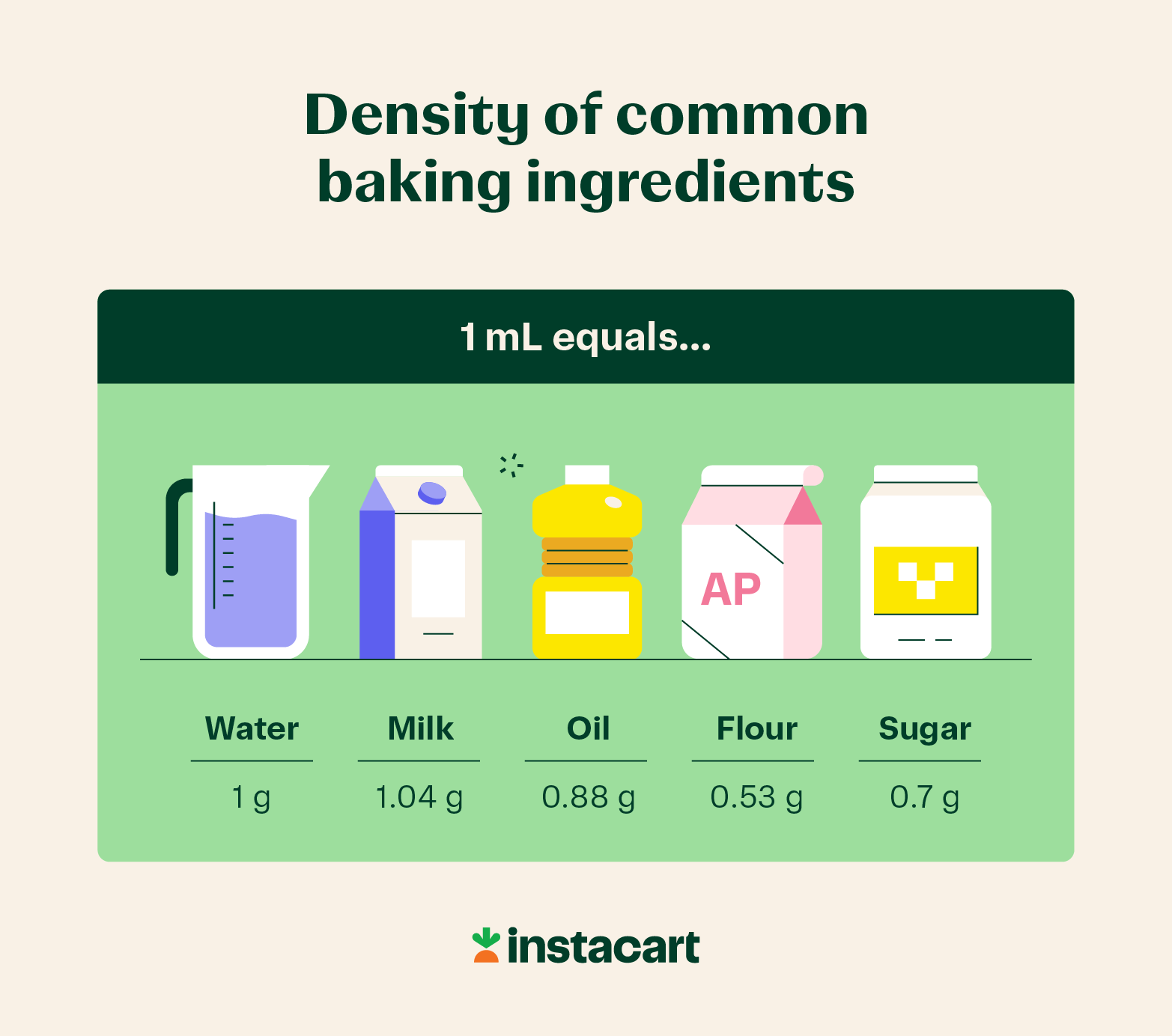
For many common liquids, especially water-based ones, 1 milliliter (ml) weighs about 1 gram (g). This makes conversion easy in the kitchen.
Water, Milk, and Juice: 1 ml ≈ 1 g
This rule works well for most everyday cooking and baking. For instance, 100 ml of water equals approximately 100 g, 250 ml of milk equals approximately 250 g (slightly denser but close enough), and 50 ml of orange juice equals approximately 50 g.
Dense Liquids Are Heavier per ml
But not all liquids follow this rule. Density matters significantly.
Liquid density comparison:
- Water: 100 g per 100 ml
- Vegetable oil: 92 g per 100 ml
- Honey: 142 g per 100 ml
- Maple syrup: 133 g per 100 ml
- Alcohol: 79 g per 100 ml
So, 100 ml of honey weighs 42% more than 100 ml of water. If you substitute based on volume alone, your recipe will be off.
Warning: Never assume 1 ml equals 1 g for syrups, oils, or alcohol unless the recipe confirms it.
Use Volume Modes with Caution
Some digital scales, like the Escali Liquid Measuring Scale, let you switch units to fluid ounces (fl oz) or milliliters (ml). These modes estimate volume based on weight, assuming the liquid has the density of water.
How Volume Mode Works
First, place your container on the scale. Second, press tare. Third, switch the unit to ml or fl oz. Fourth, pour until the target volume appears.
The scale uses internal math to convert grams to milliliters, usually at a 1:1 ratio. For example, when it detects 150 g, it displays 150 ml, which is perfect for water and close enough for milk.
Limitations of Volume Mode
These readings are estimates, not exact measurements, because the scale assumes water-like density. It cannot detect if you are pouring honey, oil, or vinegar. Accuracy drops significantly for non-aqueous liquids.
Best practice: Use grams or weight ounces for all liquids when precision matters. Do not trust ml/fl oz mode for honey, oil, or syrup unless your scale allows custom density input, which is rare in consumer models.
Choose the Right Scale

Not all kitchen scales are equally good for measuring liquids. Here is what to look for.
Essential Features to Look For
Your scale needs several key features for accurate liquid measurement:
- Tare function that supports multiple tares for multi-ingredient weighing
- Unit switching to toggle between g, oz, lb, ml, and fl oz
- High resolution of at least 1 g or 0.1 oz precision
- Capacity of minimum 3 to 5 kg (6 to 11 lb) for large bowls and batches
- Stable platform large enough to hold mixing bowls without tipping
Recommended Models
Several scales consistently perform well for liquid measurement. The OXO Good Grips Food Scale has a pull-out display for visibility under tall bowls. The Escali Primo Digital Scale offers clear labeling, reliable tare, and ml/fl oz modes. The Greater Goods Nourish Scale is eco-friendly with high precision, tare, and unit switch.
Avoid mechanical dial scales. They lack precision and tare functions.
Handle Small Amounts Carefully
While scales excel at measuring larger quantities, they have limits when dealing with tiny amounts.
Minimum Accuracy Threshold
Most kitchen scales are only accurate down to 5 grams. Below that, readings can fluctuate or be unreliable.
For small liquid ingredients, vanilla extract (1 tsp equals approximately 4.2 g) is okay on a scale if precise. Lemon juice (1 tsp equals approximately 5 g) is borderline. Use a measuring spoon if the scale wavers. Food coloring and alcohol extracts are often less than 1 g and are better measured by drop or teaspoon.
Tip: If your scale has a counting or percent mode, it may offer finer resolution, but these are not standard. Use measuring spoons for sub-5g liquids unless you own a precision micro-scale with 0.01 g resolution.
Adapt Recipes Using Fluid Ounces
Many American recipes list liquids in fluid ounces (fl oz). But if your scale only measures weight ounces (oz), you will need to convert.
General Conversion Rule
For water-like liquids, 1 fl oz equals approximately 1.04 oz by weight and is often rounded to 1:1 for simplicity. Use this quick reference:
- 1 fl oz equals approximately 30 g
- 2 fl oz equals approximately 60 g
- 4 fl oz equals approximately 120 g
- 8 fl oz (1 cup) equals approximately 240 g
Adjust for Non-Water Liquids
For greater accuracy, apply known densities. For example, to weigh 4 fl oz of honey, the volume is 4 fl oz equals approximately 118 ml. The density of honey is approximately 1.42 g/ml. The weight is 118 times 1.42 equals approximately 168 g.
So, 4 fl oz of honey does not equal 120 g but closer to 168 g. Always check ingredient density if precision is critical, such as in baking or canning.
Follow Best Practices for Accuracy
Even with a great scale, poor technique can lead to errors. Follow these tips for reliable results.
Essential Best Practices
Place the scale on a hard, flat counter, not a wobbly shelf or near a draft from a fan or stove. Vibrations affect readings. Airflow from vents, open windows, or boiling pots can cause fluctuations, so keep the scale away from heat and moving air.
After placing a container or adding liquid, wait 2 to 3 seconds for the number to stop jumping. Most scales have a stabilization symbol like a checkmark or g icon. Liquid dripping under the platform or residue on the edges can throw off future measurements, so wipe the scale after each use.
If you use the same bowl repeatedly, write down its weight. Then you can subtract it manually if the tare function fails.
Real-World Applications
Weighing liquids is not just for professional chefs. It is useful in many everyday scenarios.
Baking and Pastry
Precision matters in baking because hydration levels affect gluten development, rise, and texture. Weighing milk ensures consistent hydration. Weigh eggs individually (large egg equals approximately 50 g with shell, 44 g without). For melted butter, weigh it directly in the mixing bowl.
Pro move: Tare the bowl, add flour, tare again, add milk. No extra dishes.
Coffee Brewing
Specialty coffee relies on ratios. A common brew ratio is 1:16 (coffee to water). Twenty grams of coffee plus 320 g of water equals perfect pour-over. Weigh both coffee and water for consistency. Hot water expands slightly, but the weight remains accurate.
Home Canning and Preserving
Accurate vinegar and sugar weights ensure safe pH levels in pickles and jams. Too little vinegar risks spoilage. Too much sugar makes it overly sweet with poor set. Weighing ensures shelf stability and food safety.
DIY and Craft Projects
Measuring essential oils, alcohol, or resin for candles, perfumes, or epoxy is more accurate by weight. Ten grams of fragrance oil equals exact scent strength. Fifty grams of resin plus 10 g hardener equals perfect cure. This method is also useful for postage, weighing small liquid packages accurately.
Frequently Asked Questions About Measuring Liquid on a Scale
Can I measure any liquid on a kitchen scale?
Yes, you can measure any liquid on a kitchen scale using the tare function. Place your container on the scale, press tare to zero out the container weight, then pour your liquid until you reach the desired weight. This works for water, milk, oil, honey, syrup, and more.
What is the difference between ounces and fluid ounces?
Ounces (oz) measure weight, while fluid ounces (fl oz) measure volume. A scale measures in weight ounces. Eight ounces of honey and 8 ounces of water weigh the same but take up different amounts of space. Fluid ounces tell you how much space a liquid occupies, not how heavy it is.
Does 1 ml always equal 1 gram?
No, 1 ml equals approximately 1 gram only for water-like liquids such as water, milk, and juice. Dense liquids like honey, syrup, and oil have different densities. One hundred ml of honey weighs 142 g, while 100 ml of vegetable oil weighs only 92 g. Always check the density if precision matters.
Should I use the ml or fl oz mode on my scale?
Use ml or fl oz mode only for water-like liquids. These modes assume the liquid has the density of water, so accuracy drops significantly for honey, oil, syrup, or alcohol. For best results, measure in grams or weight ounces instead.
How do I measure sticky liquids like honey or molasses?
Weighing sticky liquids on a scale is much easier than using a measuring cup. Simply tare your container, then pour directly until you reach the target weight. No scraping required. This eliminates the mess and ensures accurate measurement every time.
What if my recipe uses fluid ounces but my scale only shows weight?
Convert fluid ounces to grams using the density of your liquid. For water-like liquids, 1 fl oz equals approximately 30 g. For honey, 1 fl oz equals approximately 42 g. Multiply the fluid ounce amount by the appropriate density factor to get an accurate weight measurement.
Key Takeaways for Measuring Liquid on a Scale
Switching to weight-based measurement transforms how you cook. Always tare the container before adding liquid to exclude its weight. Weigh in grams or weight ounces for the best accuracy. Remember that 1 ml equals approximately 1 g only for water-like liquids, not for honey, oil, or syrup. Use ml/fl oz modes cautiously because they assume water density and lose accuracy with dense liquids.
Scales dramatically reduce mess, especially with sticky liquids like honey and molasses. This method is ideal for baking, coffee brewing, home canning, and craft projects. Avoid volume cups when precision or cleanup is a concern.
For most home cooks, the best approach is using a digital kitchen scale with tare and unit switching. Measure all liquids in grams or weight ounces. Convert fluid ounces to grams using known densities when needed. Reserve measuring cups for non-sticky liquids when precision is not critical.
By switching to weight-based measurement, you gain accuracy, consistency, and efficiency. You will also say goodbye to sticky measuring cups forever. Your recipes will turn out better, your kitchen will stay cleaner, and you will have total confidence in every measurement you make.