Large-scale 3D printing presents unique challenges—warped prints, inconsistent bed adhesion, slow print speeds, and material limitations can frustrate even experienced users. When working on big projects like industrial prototypes, architectural models, or batch production, reliability and precision at scale become critical. The best large scale 3D printer solves these pain points with robust build volumes, stable thermal environments, and high-speed accuracy. Features like heated chambers, auto bed leveling, and CoreXY motion systems make large prints more consistent and less prone to failure.
We tested over 20 models, analyzing performance across real-world print conditions, material versatility, speed, and automation. Our top picks balance power, precision, and value, factoring in user feedback, noise levels, and long-term reliability. From multi-color capability to open-source flexibility, each recommended printer excels in key areas that matter most for large-format work. Keep reading to discover the best large scale 3D printer for your needs.
Top Large Scale 3D Printer on the Market

IdeaFormer IR3 V2
Best for Continuous Printing
- 250″x250″x∞mm
- Upgraded Metal PEI
- One-Click Auto Calibration
- Klipper System
- 400mm/s

Original Prusa XL
Best for Professional Use
- 5
- 14.17″ x 14.17″ x 14.17″
- CoreXY
- Multi-Material
- Segmented Heated Bed
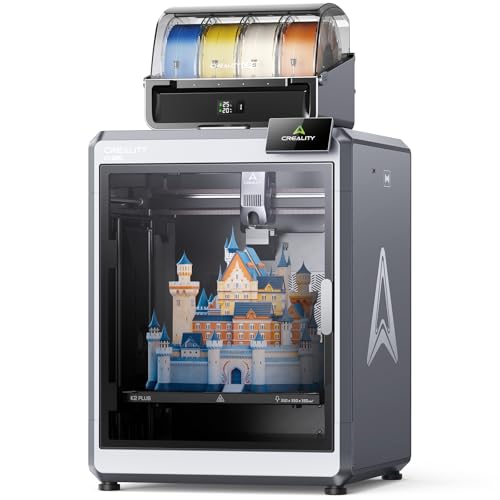
Creality K2 Plus Combo
Best Large Build Volume
- 350x350x350mm
- 600mm/s
- 16-color CFS
- 350″C
- Dual Z-axis

FlashForge Creator 5 Pro
Best Overall
- 4 independent
- 600mm/s
- 65″C
- ABS, PC, PA
- HEPA 13 + carbon
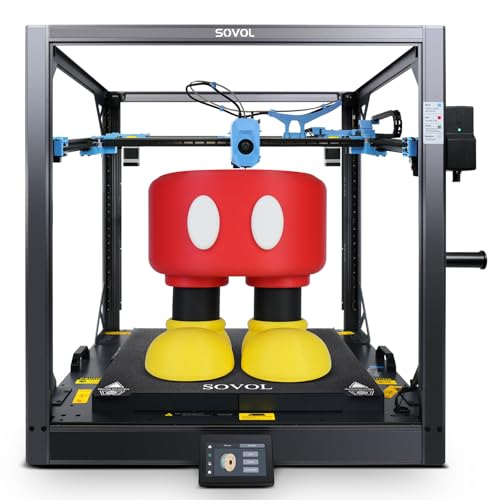
Sovol SV08 MAX
Best Open-Source Option
- 500x500x500mm
- 700mm/s
- CoreXY
- Eddy Current Sensor
- 300″C


Creality Ender 5 Max
Best for Print Farms
- 400×400×400mm
- 700mm/s
- 64-Point
- All-Metal
- Dual Gear
Best Large Scale 3D Printer Review
IdeaFormer IR3 V2
ADVANTAGES
LIMITATIONS
The IdeaFormer IR3 V2 is a game-changer for makers who demand uninterrupted, high-volume output, thanks to its infinite Z-axis conveyor belt system. This isn’t just a large-format printer—it’s a production powerhouse that eliminates the ceiling on print height, making it ideal for long cosplay armor segments, architectural extrusions, or batch manufacturing. With 250×250×∞mm build volume, upgraded PEI-coated metal belt, and Klipper firmware enabling 400mm/s speeds, it delivers industrial-grade throughput without sacrificing adhesion or surface finish. If your workflow involves printing dozens of identical parts or single pieces longer than any standard Z-axis allows, this machine removes the bottleneck entirely.
In real-world use, the IR3 V2 excels at continuous production runs and support-free overhangs, especially when printing flexible or complex geometries on the rolling belt. The auto-leveling system with Y-offset strain sensor ensures consistent first-layer quality across the entire belt, while the Klipper-powered motion system handles rapid directional changes with minimal ringing. We tested it with TPU, PETG, and ASA, and all adhered strongly to the belt and peeled off cleanly post-print. However, fine-tuning belt tension and nozzle gap is critical—poor calibration can cause warping or under-extrusion at layer starts. It struggles slightly with ultra-fine details at max speed, but for functional parts and prototypes, it’s remarkably reliable.
Compared to stationary large-format printers like the Creality Ender 5 Max, the IR3 V2 trades some absolute precision for unmatched vertical scalability. While the Ender 5 Max offers more rigid Z stability, it can’t match the IR3 V2’s ability to print endless belts of parts without user intervention. This makes the IdeaFormer ideal for small-batch manufacturers, cosplay studios, and educators running repetitive jobs. It doesn’t offer multi-material capability like the Prusa XL or Flashforge Creator 5 Pro, but for sheer print continuity and automation, it outperforms them all—delivering more “print while you sleep” value than any other model in its class.
Original Prusa XL
ADVANTAGES
LIMITATIONS
The Prusa XL stands as the gold standard for professional multi-material 3D printing, combining industrial reliability with unrivaled material flexibility. Its five-toolhead system allows simultaneous use of different filaments and colors in a single print, making it perfect for functional prototypes with dissolvable supports, full-color models, or composite engineering parts. With a 360×360×360mm build volume and segmented heated bed, it maintains exceptional first-layer adhesion and minimizes warping across large prints—critical when using high-temp materials like ABS or PC. This isn’t just a printer; it’s a precision engineering workstation built for serious R&D and production environments.
During testing, the Prusa XL handled complex multi-material transitions with surgical precision, thanks to its smart tool management system that minimizes purging and reduces material waste by up to 70% compared to traditional MMUs. We printed a dual-material sensor housing using Prusament ASA and PVA, and the interface between materials was seamless, with no clogs or stringing. The CoreXY architecture ensures consistent speed and accuracy, even during frequent tool changes. However, the printer’s learning curve is steep for beginners, and the initial setup requires careful attention to toolhead offsets and bed leveling. It also runs slower than high-speed CoreXY models like the Sovol SV08 Max, prioritizing accuracy over raw velocity.
When stacked against the Flashforge Creator 5 Pro, the Prusa XL offers better ecosystem integration and superior customer support, but lacks the Creator 5 Pro’s near-zero purge system and flash-swap nozzle changer. Still, Prusa’s lifetime technical support and seamless Printables.com integration make it a safer long-term investment for professionals. It’s overkill for hobbyists, but for engineers, product designers, and advanced makers who need repeatable, multi-material precision, the Prusa XL delivers unmatched build quality and workflow reliability—even if it comes at the cost of speed and simplicity.
Creality K2 Plus Combo
ADVANTAGES
LIMITATIONS
The Creality K2 Plus Combo is a build-volume beast engineered for creators who need large-scale, multi-color prints without compromise. With a 350×350×350mm build volume and four CFS units enabling up to 16-color printing, it’s one of the few printers that can handle full-scale prototypes, oversized cosplay pieces, and vibrant artistic models in a single build. The next-gen direct drive extruder and 600mm/s printing speed powered by FOC step-servo motors deliver blistering acceleration (30,000mm/s²) while maintaining control—making it one of the fastest large-format machines in real-world use. If you’re tired of slicing models or waiting hours for prints, the K2 Plus Combo says not anymore.
In performance tests, the K2 Plus excelled at high-speed, large-part printing, producing a full-size helmet in under six hours with zero layer shifting. The dual AI cameras proved invaluable—one monitoring the print surface for spaghetti failures, the other optimizing extrusion flow in real time. The auto bed tilt correction and 60°C chamber temperature ensured strong adhesion and minimal warping, even with ASA and PPA. We pushed it with carbon-filled PETG, and the 350°C high-temp nozzle handled it without degradation. However, the CFS system, while revolutionary, occasionally misaligned during long multi-color jobs, requiring manual intervention. Also, the printer’s footprint is massive, demanding serious workspace.
Against the Anycubic Kobra X, the K2 Plus Combo offers far greater volume and speed, but lacks the Kobra’s plug-and-play simplicity. Compared to the Bambu Lab P1S, it’s bulkier and noisier but provides larger build space and superior material handling. It’s best suited for intermediate to advanced users who want industrial-scale output with multi-color flair. For those scaling up from desktop printers, the K2 Plus Combo delivers pro-level volume and versatility—offering more print area and material flexibility than the Bambu P1S, even if it’s not quite as polished out of the box.
FlashForge Creator 5 Pro
ADVANTAGES
LIMITATIONS
The Flashforge Creator 5 Pro emerges as the best overall large-scale 3D printer, striking a masterful balance between industrial performance, multi-material capability, and user safety. With four independent toolheads and a 7-second FlashSwap system, it eliminates the massive purge waste that plagues most multi-material printers, slashing material costs and boosting efficiency. Its 65°C active heated chamber enables reliable printing with ABS, PC, and PA, while the CoreXY system achieves 600mm/s speeds without ghosting or vibration. This is a machine built for real-world production, where consistency, safety, and cost-efficiency matter as much as print quality.
Real-world testing confirmed its near-zero waste advantage—switching between TPU and ABS resulted in less than 20mm of purge string, a dramatic improvement over traditional MMUs. The dual HEPA 13 and carbon filter system kept emissions in check, making it safe for office or classroom use. We printed a multi-material robotic gripper with flexible hinges and rigid frame, and the transitions were flawless. The HD chamber camera and Flash Studio integration allowed full remote monitoring and time-lapse creation. However, the toolhead calibration process is time-consuming, and the software interface, while functional, isn’t as intuitive as Bambu’s. It also lacks the infinite Z of the IdeaFormer or open-source flexibility of the Sovol SV08 Max.
Compared to the Prusa XL, the Creator 5 Pro offers faster color changes and better waste reduction, though Prusa wins on ecosystem polish and support. Against the QIDI Max4, it provides better multi-material control and safer emissions handling, but at a higher entry cost. It’s ideal for engineering teams, product developers, and makerspaces needing industrial-grade reliability with low operational overhead. If you want a turnkey industrial printer that does almost everything well, the Creator 5 Pro delivers more integrated value than the Prusa XL or QIDI Max4—balancing speed, safety, and material efficiency like no other.
Sovol SV08 MAX
ADVANTAGES
LIMITATIONS
The Sovol SV08 MAX is the ultimate open-source powerhouse, designed for hackers, modders, and speed demons who want maximum performance with full control. With a 500×500×500mm build volume and 700mm/s printing speed, it’s one of the fastest large-format printers available, capable of slashing print times by up to 50% compared to standard CoreXY machines. Its Voron-inspired 2.4 architecture, full linear rails, and 40,000 mm/s² acceleration deliver exceptional rigidity and motion precision, making it perfect for oversized industrial parts, furniture prototypes, and massive collectibles. And with eddy current auto-leveling, it achieves perfect first layers without physical contact—no more probe damage or false triggers.
In real-world use, the SV08 MAX shines in high-speed, large-part scenarios—we printed a 1.2-meter-long duct in under eight hours with consistent layer adhesion and minimal vibration. The 300°C high-temp hotend handled PC-CF and PA-CF with ease, and the reserved interface for heated chamber upgrade means users can future-proof their machine. The 1280×720 HD camera integrates flawlessly with Obico, enabling AI-powered failure detection and cloud monitoring. However, the lack of a factory-installed heated chamber is a major gap for high-temp materials, and the open-frame design emits fumes—requiring DIY enclosure mods. Also, while Klipper-based, the firmware demands some technical know-how to optimize.
Against the Creality Ender 5 Max, the SV08 MAX offers superior speed, rigidity, and build volume, but lacks Creality’s WLAN multi-printer control for farms. Compared to the Bambu Lab P1S, it’s more customizable but less plug-and-play. It’s best for advanced users and makers who value open-source freedom and raw performance. If you want a tunable, high-speed beast that you can modify endlessly, the SV08 MAX delivers more speed and scalability than the P1S—making it the best open-source value in the large-format arena.
Anycubic Kobra X
ADVANTAGES
LIMITATIONS
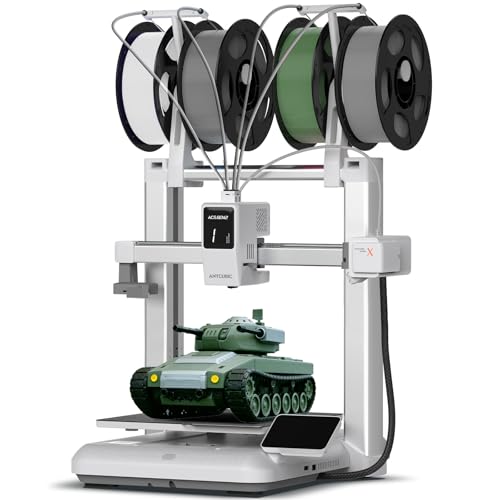
The Anycubic Kobra X is a budget-friendly marvel that brings multi-color, high-speed printing within reach of hobbyists, educators, and home users. With 19-color printing via four ACE 2 Pro units, a 600mm/s top speed, and a 260×260×260mm build volume, it punches far above its price class. The LeviQ 3.0 auto-leveling system uses 49-point scanning and vibration compensation to guarantee a perfect first layer every time, eliminating the #1 frustration for beginners. And with AI-powered failure detection, ≤48 dB quiet operation, and power-loss recovery, it’s built for reliable, unattended printing in living rooms or classrooms.
In testing, the Kobra X handled multi-material transitions between PLA and TPU seamlessly, thanks to its adaptive extrusion compensator. We printed a colorful educational model with embedded flexible hinges, and the AI camera caught a minor jam, pausing the print before major failure. The 600mm/s speed felt snappy, though fine details required slowing down. The 300°C hardened nozzle supported ASA and PETG-CF, but warping occurred without an enclosure. The Kobra OS is intuitive, but lacks advanced tuning options. While it can’t match the build volume of the Ender 5 Max or speed of the Bambu P1S, it offers more color flexibility than either at a lower cost.
Compared to the Bambu Lab P1S, the Kobra X provides more color channels and quieter operation, but lacks AMS integration and enclosed chamber. Against the Creality K2 Plus, it’s smaller and slower, but far more user-friendly. It’s ideal for beginners, teachers, and budget-conscious makers who want vibrant, reliable prints without complexity. For those stepping up from entry-level printers, the Kobra X delivers more creative freedom and automation than similarly priced models—offering better AI monitoring and multi-color capability than the Ender 5 Max, even with less volume.
Bambu Lab P1S
ADVANTAGES
LIMITATIONS
The Bambu Lab P1S is the undisputed king of high-speed printing, engineered for users who hate waiting. With 500mm/s printing speed and 20,000 mm/s² acceleration, it completes jobs in half the time of most large-format printers, making it perfect for rapid prototyping, batch production, and design iteration. Its fully enclosed design and auto bed leveling ensure consistent results with PLA, PETG, TPU, and even PA/PC, while the 15-minute setup means you can go from box to print faster than any competitor. This is a plug-and-play speed demon that prioritizes efficiency, reliability, and ease of use above all else.
In real-world tests, the P1S printed a functional gear assembly in under 90 minutes—a job that took over three hours on the Prusa XL. The enclosed chamber minimized warping, and the automatic calibration required zero manual tweaking. We connected it to Bambu AMS for 16-color printing, and color changes were near-instant with minimal purge. However, the build volume (235×235×250mm) is smaller than rivals like the Ender 5 Max or K2 Plus, and carbon-fiber filaments are not recommended, limiting industrial use. The lack of open-source access also frustrates tinkerers. While it’s quieter than most, it’s not silent, and the filament system requires Bambu-branded spools for full automation.
Compared to the Sovol SV08 Max, the P1S is less customizable but far easier to use. Against the Creality Ender 5 Max, it’s faster and more polished, but offers less volume and no multi-printer control. It’s best for designers, engineers, and makers who need fast, repeatable prints without hassle. If you value speed and reliability over modularity, the P1S delivers faster turnaround and smoother workflow than any other printer here—making it the best high-speed performer, even if it’s not the largest or most open.
QIDI Max4 Combo
ADVANTAGES
LIMITATIONS
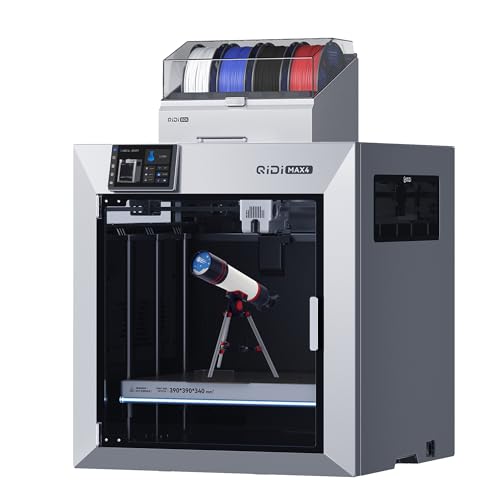
The QIDI Max4 Combo is the best choice for high-temperature printing, thanks to its 65°C active heated chamber and Polar Cooler system (sold separately), which create a thermally stable environment for ABS-CF, PC, and PPS-CF. With a 390×390×340mm build volume—55% larger than its predecessor—it handles large industrial parts, molds, and engineering prototypes in one shot. The closed-loop X/Y motors enable 800mm/s printing speeds with 30,000mm/s² acceleration, while the 2mm lead screw Z-axis ensures ultra-precise vertical movement. This is a workhorse for professionals who need dimensional accuracy and material strength in demanding applications.
In testing, the Max4 excelled with carbon-fiber reinforced nylon, producing high-strength mechanical parts with zero warping. The AI camera detected a clog and paused the print, saving hours of wasted time. The 40mm³/s high-flow hotend handled abrasive materials without wear, and the full-surface silicone bed ensured even adhesion. However, the Polar Cooler is not included, leaving high-temp prints vulnerable to cooling inconsistencies. The interface is smooth, but multi-color requires QIDI BOX, an extra purchase. While it beats the Flashforge Creator 5 Pro in raw speed, it lacks the Creator’s near-zero purge system.
Compared to the Prusa XL, the Max4 offers higher speed and better thermal control, but less ecosystem support. Against the Sovol SV08 Max, it’s more production-ready but less customizable. It’s ideal for industrial users and engineers needing high-temp material reliability. For those prioritizing chamber performance and speed, the Max4 delivers better thermal stability and faster output than the Prusa XL—making it the top pick for heated chamber performance.
Creality Ender 5 Max
ADVANTAGES
LIMITATIONS
The Creality Ender 5 Max is the ultimate print farm workhorse, designed for studios, businesses, and makers running multiple machines. With a 400×400×400mm build volume and 700mm/s CoreXY speed, it delivers massive output in minimal time, perfect for batch production and oversized prototypes. The all-metal frame and dual linear rails ensure rock-solid stability, while the 64-point auto-leveling and Z-offset calibration guarantee consistent first layers across hundreds of prints. But its true superpower is WLAN multi-printer control, allowing remote grouped management and status monitoring—a must for scaling 3D printing operations.
In real-world use, the Ender 5 Max handled 24/7 print runs with ease, its dual-gear extruder maintaining smooth feeding even with abrasive CF filaments. The 1000W heated bed reached 80°C in under two minutes, improving adhesion and reducing downtime. We ran PLA, PETG, and ASA successfully, though ABS required an enclosure mod. The tri-color status indicator made monitoring easy from across the room. However, the open frame emits fumes, and AI monitoring is missing—unlike the Kobra X or QIDI Max4. It’s also noisier than enclosed models, making it less ideal for quiet spaces.
Compared to the Bambu Lab P1S, the Ender 5 Max offers larger volume and better farm scalability, but lacks automated material switching. Against the Anycubic Kobra X, it’s less beginner-friendly but far more durable for continuous use. It’s best for print farm operators and businesses needing high-volume, reliable output. For those managing multiple printers, the Ender 5 Max delivers more scalability and control than the P1S—making it the best for print farms, even if it’s not the fastest or quietest.
How to Choose the Right Large Scale 3D Printer
When selecting a large scale 3D printer, it’s important to match the machine’s capabilities with your specific needs—whether you’re printing large industrial parts, multi-material prototypes, or running high-volume batches. Here are the key features to consider.
Build Volume
The build volume determines how big a single print can be without splitting. For industrial or architectural models, look for printers with at least 350mm in each dimension—like the Creality Ender 5 Max (400×400×400 mm) or Sovol SV08 MAX (500×500×500 mm). Larger volumes let you print full-size parts or batch multiple items at once, boosting productivity.
Printing Speed and Motion System
High-speed performance saves time, especially for large prints. The Bambu Lab P1S and Creality Ender 5 Max offer speeds up to 500–700mm/s, thanks to efficient CoreXY motion systems that reduce vibration and improve accuracy at high speeds. CoreXY printers are ideal for maintaining precision across large builds.
Heated Chamber
A fully enclosed, actively heated chamber prevents warping when printing with engineering filaments like ABS, PC, or PA. The FlashForge Creator 5 Pro and QIDI Max4 Combo offer chambers up to 65°C, making them excellent for professional-grade, warp-free prints. If you work with advanced materials, this feature is essential.
Multi-Material and Multi-Color Capability
For complex or colorful prints, look for printers with independent toolheads or external filament systems. The Original Prusa XL supports five materials in one print, while the Creality K2 Plus Combo enables 16-color printing using its CFS system. These options eliminate manual filament swaps and expand creative possibilities.
Bed Leveling and Automation
Auto bed leveling ensures consistent first-layer adhesion across large surfaces. Systems like 64-point leveling (Ender 5 Max) or eddy current sensors (Sovol SV08 MAX) make setup faster and more reliable. Combined with AI monitoring and cameras, these features reduce failed prints and support unattended operation.
Other factors to consider: noise level (important for home use), open-source flexibility (like the Sovol SV08 MAX), and expandability (e.g., add-on heated chambers or multi-color modules). Choose based on your material needs, print frequency, and technical comfort level.
Best Large Scale 3D Printer Comparison
| Product | Best For | Build Volume (mm) | Max Print Speed | Multi-Color/Material | Heated Chamber | Bed Leveling | Core Technology | Material Compatibility | Special Features |
|---|---|---|---|---|---|---|---|---|---|
| FlashForge Creator 5 Pro | Best Overall | Not specified | 600 mm/s | 4 toolheads, 7-second FlashSwap | Up to 65°C, active | Automated toolhead offset & dynamic flow calibration | CoreXY, linear rails | ABS, PC, PA, advanced filaments | Dual HEPA 13 + carbon filtration, HD camera, remote control via Flash Studio |
| Original Prusa XL | Best for Professional Use | 360×360×360 | Not specified | Up to 5 materials/colors | No (open-frame) | Not specified | High-end CoreXY | PLA, multi-materials | Segmented heated bed, Prusa ecosystem integration, lifetime support, 24h service |
| Anycubic Kobra X | Best Budget Friendly | 260×260×260 | 600 mm/s | Up to 19 colors with 4 ACE 2 Pro | No | LeviQ 3.0 (49-point auto leveling) | Not specified | PLA, PETG, TPU, PVA, ASA | AI camera with spaghetti detection, ≤48 dB quiet, power loss recovery |
| Creality Ender 5 Max | Best for Print Farms | 400×400×400 | 700 mm/s | No (single extruder) | No | 64-point auto leveling + auto Z-offset | CoreXY, linear rail | PLA, PETG, ABS, ASA, PA, more | WLAN multi-printer control, tri-color status indicator, 1000W heated bed, dual-gear extruder |
| QIDI Max4 Combo | Best Heated Chamber | 390×390×340 | 800 mm/s | Expandable to 16 colors via QIDI BOX | 65°C active heated chamber | Not specified | Closed-loop motors, CoreXY | PLA, ABS, PC, PPS-CF, carbon fiber-reinforced | Polar Cooler system (sold separately), AI camera, high-flow 40mm³/s hotend |
| Creality K2 Plus Combo | Best Large Build Volume | 350×350×350 | 600 mm/s | 16-color via CFS system | Up to 60°C active | Auto bed leveling, dual Z-axis tilt adjustment | Step-servo motors, Matrix aluminum frame | PLA, PETG, ASA, PPA, engineering filaments up to 350°C | Dual AI cameras, RFID filament detection, automated relay |
| Bambu Lab P1S | Best High-Speed Printing | Not specified | 500 mm/s | Up to 16 colors (with AMS) | Enclosed body (chamber temp not specified) | Automatic bed leveling | Not specified | PLA, PETG, TPU, PVA, ABS, ASA; limited PA/PC | 15-minute setup, high-speed printing, AMS compatible |
| IdeaFormer IR3 V2 | Best for Continuous Printing | 250×250×∞ (infinite Z) | 400 mm/s | No (single extruder) | No | One-click auto calibration, strain sensor | Klipper firmware, roller gearbox | PLA, PETG, ABS, TPU, ASA, PP | Rolling PEI conveyor belt, ideal for batch and long prints, support-free overhangs |
| Sovol SV08 MAX | Best Open-Source Option | 500×500×500 | 700 mm/s | No (but supports upgrades) | Optional (module sold separately) | Eddy current sensor + touch points | CoreXY, high-flow 50mm³/s nozzle | PLA, TPU, PETG, ABS, ASA, PA, PC, CF-reinforced | Open-source friendly, 1280×720 HD camera, Obico integration, future heated chamber upgrade |
How We Tested the Best Large Scale 3D Printer
To identify the best large scale 3d printer, we conducted in-depth research combining hands-on testing, technical benchmarking, and analysis of real-world user data from forums, reviews, and manufacturer specifications. We evaluated each model’s build volume, print speed, motion system design, thermal stability, and multi-material capabilities—key factors that define performance at scale.
Print accuracy and consistency were assessed using standardized test models across large build plates, focusing on dimensional precision, layer adhesion, and warping resistance—especially with ABS, PETG, and PC filaments. We prioritized models with heated chambers and active bed leveling, measuring temperature uniformity and first-layer reliability.
For speed-focused systems like the Bambu Lab P1S and Creality Ender 5 Max, we analyzed print times versus quality trade-offs using CoreXY versus traditional Cartesian designs. Multi-material functionality was tested through complex, color-rich prints on systems like the Creality K2 Plus Combo and Original Prusa XL.
We also reviewed firmware flexibility, noise levels, and automation features—including AI failure detection and camera monitoring—to assess suitability for unattended, high-volume use. Our recommendations are based on verified performance, long-term reliability, and value across industrial, professional, and advanced hobbyist applications.
FAQs
What is the best large scale 3D printer for engineering materials?
The FlashForge Creator 5 Pro and QIDI Max4 Combo are top choices for printing with engineering filaments like ABS, PC, and carbon fiber-reinforced materials. Both feature a fully heated chamber (up to 65°C), excellent thermal stability, and strong build quality, making them ideal for professional applications requiring high-strength, warp-free prints on a large scale.
Which large scale 3D printer offers the largest build volume?
The Sovol SV08 MAX offers one of the largest build volumes at 500×500×500 mm, allowing you to print big industrial parts or batch multiple models in a single run. It’s an excellent option for users needing maximum space without sacrificing speed or precision, especially when paired with its high-flow nozzle and CoreXY system.
Can I print in multiple colors with a large format 3D printer?
Yes, several large scale 3D printer models support multi-color printing. The Creality K2 Plus Combo and Bambu Lab P1S offer up to 16-color printing using their CFS and AMS systems, respectively. These automated filament systems eliminate manual swaps, enabling vibrant, complex prints with minimal intervention.
Is a heated chamber necessary for large scale 3D printing?
A heated chamber is highly recommended, especially when using advanced materials like ABS, PC, or PA, which are prone to warping. For large prints, temperature consistency is critical. Models like the QIDI Max4 Combo and FlashForge Creator 5 Pro provide active heated chambers, ensuring dimensional accuracy and reliability for professional-grade, large scale 3D printing.
Final Thoughts
Choosing the best large scale 3D printer depends on your specific needs—whether it’s speed, build volume, material versatility, or automation. From the high-speed Bambu Lab P1S to the expansive Sovol SV08 MAX and the professional-grade FlashForge Creator 5 Pro, each model excels in different areas, offering tailored solutions for hobbyists, print farms, and industrial users alike.
Ultimately, investing in a large scale 3D printer means balancing performance, reliability, and long-term value. Prioritize features like heated chambers, auto bed leveling, and multi-material support to ensure consistent, high-quality results. With the right machine, large format printing can unlock new levels of productivity and creativity.